A chat with Stefano Portu, Founder & CEO of ShopFully
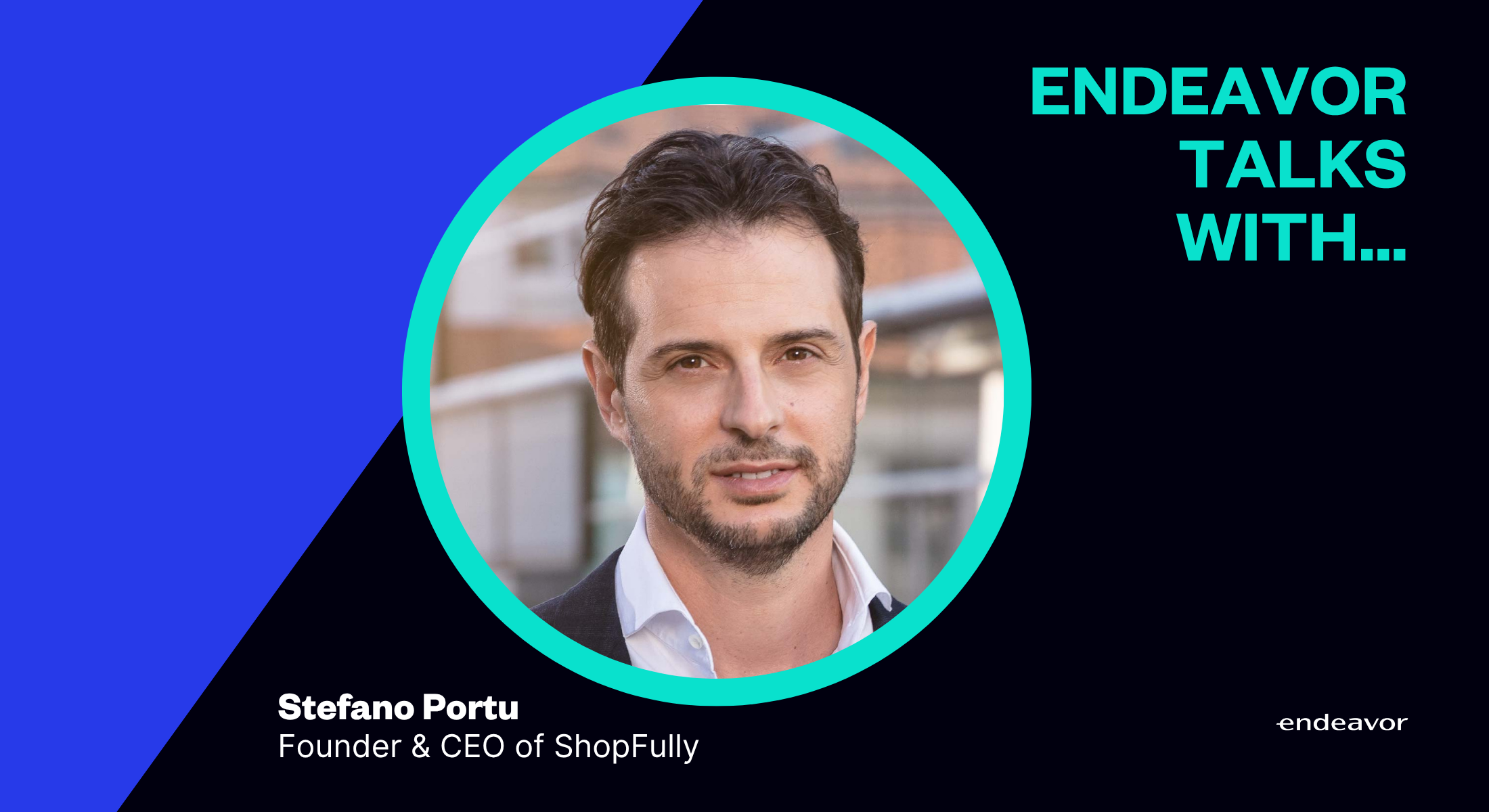
Welcome back to Endeavor Talks With…!
This time we sat down with Stefano Portu, Founder & CEO of ShopFully, a digital platform that connects shoppers with physical retailers through drive-to-store digital marketing solutions, increasing customer engagement and foot traffic in traditional stores.
Happy reading!
1) TELL US ABOUT YOURSELF: WHERE DO YOU COME FROM, WHAT IS YOUR BACKGROUND?
I studied marketing and communication in Bologna and London, learning the importance of developing an international mindset. Before graduating, I came across the third element that has been fundamental in directing my career: technology. It was 1999, and the first big internet wave was still building when I met Mauro Del Rio, who was founding Buongiorno. I was immediately enthusiastic about taking part in one of the first Italian start-ups, and I ended up in the very early team. Eight years later, after helping build Buongiorno into a public company with 1,000+ employees, offices in 30 countries, and global leadership in mobile marketing, I moved to Gedi Group, one of the largest Italian media groups and a pioneer in the digital transformation of news. In these two experiences, I was lucky enough to do a lot, see two big industries completely transformed by technology, and learn many valuable lessons.
2) FOR EXAMPLE?
I saw how superior technology can struggle when it doesn’t match customers’ needs. In my first decade in digital, I saw MMS fail to replace SMS and interactive newspapers never take off on tablets, despite all the experts’ forecasts and huge investments. That taught me that technology is always a means to an end: improving consumers’ lives. Contributing to the disruption of the telco and media industries, I learned by experience that technology and products only exist in relation to consumers, who have their own habits and often need incentives and valid reasons to change them.
Understanding consumers and what technology can really do for them is the true key for any successful innovation.
3) SHOPFULLY IS THE COMPANY WITH WHICH YOU JOINED ENDEAVOR. HOW DID IT COME ABOUT, AND WHAT WAS THE SPARK THAT CONVINCED YOU TO THROW YOURSELF INTO THIS VENTURE?
I founded ShopFully, the company I lead as CEO, with my friend and former colleague Alessandro Palmieri, with whom I had already shared the early years at Buongiorno. We thought retail was one of the few industries left to transform through technology, and a huge one (the largest sector in the world, worth almost 30 billion dollars). Everyone looked at the e-commerce side of the retail transformation opportunity, but we saw a different angle: 90% of sales still happened in stores, while the majority of shopping decisions were shifting to digital. What a gap! We immediately wanted to build a company using technology to connect digital shoppers and physical stores and make shopping in stores easier. We started by digitizing catalogs, the multi-billion-euro backbone of retail communication, and quickly embraced a larger vision, with smartphones becoming the true remote control for shopping, connecting millions of shoppers and hundreds of thousands of stores.
4) YOUR BUSINESS AIMS TO INNOVATE AN INDUSTRY WITH A VERY ENTRENCHED MODUS OPERANDI. HAVE YOU ENCOUNTERED ANY RESISTANCE?
Any time you want to change an industry, especially a B2B one, you are bound to meet a certain amount of resistance. That’s normal and makes sense, because you’re talking to people and organizations who have had success doing other things. The challenge is to convince your counterparts that there is a real upside in embracing the new way of doing things.
5) HOW DID YOU GET YOURSELF HEARD AND TRUSTED? WHAT WERE YOUR STRENGTHS?
There is no magic formula, but it was crucial for us to adopt very early an approach where the benefits of our proposition could be measured in numbers. For hundreds of retail chains and brands, ShopFully has become the partner of choice to boost sales in local stores. We do this by engaging consumers in the last mile between their couch at home and the cashier in store, with a numbers-driven, performance-oriented, and measurable approach, through a platform that applies AI and machine learning.
Retail is a very pragmatic sector compared to others, and a key to a fruitful relationship was making clear that we were not talking about digital for the sake of novelty, but about transforming the market and growing their businesses.
We really want to give digital superpowers to physical stores and chains and make them more competitive in an increasingly omni-channel environment.
6) HOW DO YOU SEE THE RETAIL MARKET AND CONSUMER HABITS FROM YOUR PERSPECTIVE?
The pandemic has accelerated processes already underway and radically and irreversibly changed the retail market. By now it is clear that many consumers buy both online and (largely) offline, but they develop expectations that can’t be confined to one space or the other. For example, some customers have learned online to expect certain prices, choose from huge inventories, access information by themselves through digital devices, not wait at checkout, and have free returns. These habits might have developed online, but customers now also apply these expectations to their shopping trips in physical stores, raising the bar for them too. At the same time, strong pressure to innovate physical retail comes from huge players like Amazon and Alibaba, who started from e-commerce but have now expanded to brick-and-mortar, changing the whole game. It is truly becoming an omnichannel market, and the challenge, once again, is meeting consumers’ expectations.
7) LET’S CHANGE TOPIC. WHAT SHOULD BE IN THE “TOOLBOX” OF SOMEONE LOOKING TO LAUNCH A START-UP?
First of all, you need a real problem to solve and you must be really committed to it. Then you need to be able to break it down into measurable milestones to be achieved (and enjoyed!) one at a time. In this process, and here is one of the great paradoxes for entrepreneurs, you need to be both incredibly stubborn in pushing your new vision and incredibly open in listening to feedback.
8) WHAT MAKES THE DIFFERENCE BETWEEN A SUCCESSFUL START-UP AND ONE THAT FAILS?
There are 3 factors. You can control 2 of them: team and culture. Team is the most important: a great, talented, and diverse team can reshape the mission, adapt to the market, and ultimately succeed in almost all conditions. Assembling a great team is the number one task for a founder. Culture is another very important factor for me: there is no point in hiring great people if you don’t provide an environment that is open to feedback and entrepreneurial enough. And beyond a certain company size, without a strong culture, maintaining the same speed as a start-up can be very challenging.
There’s a third factor, the one you can’t control and the one that most people don’t want to admit: luck.
Recognizing its role helps us be more grateful and humble, learning not just from success stories but also from less successful ones.
9) HOW DO YOU ATTRACT TALENT? WHAT QUALITIES DO YOU THINK ARE MOST IMPORTANT IN TODAY’S BUSINESS WORLD?
At ShopFully we are very proud of the team we have built together: we are over 200 people from 16 different nationalities, and still growing. We acknowledge that our future growth largely depends on us doing even better in this area, and we are determined to do so. We follow 2 clear principles: increasing talent density and growing diversity, because the world is complex and you want to look at it with the richness of different perspectives. As for talent, we focus on 3 main components: a high level of analytical or creative intelligence, a strong entrepreneurial drive, and the ability to be a team player.
10) LET’S TALK ABOUT MISTAKES: WHICH ONES DID YOU MAKE AND WHAT DID YOU LEARN?
There are 3 kinds of recurring mistakes that I learned a lot from. The first is tolerating gray areas. When you lead a fast-growing company, you have a lot on your plate, and sometimes it can be tempting to leave things unclear or accept compromises to save time and jump to the next item on the to-do list. However, I have gradually learned that clarity is essential, and all the effort invested in establishing a shared view pays back abundantly in speed and quality. The second mistake concerns feedback: passing on sweetened feedback to colleagues, or not requesting enough feedback for yourself. You can only manage what you see, and you want to see as much as you can. The third is postponing hard decisions, which rarely changes their direction and often ends up costing you more.
11) WHAT IS YOUR EXPERIENCE WITH ENDEAVOR?
I truly believe that feedback and inspiration from a network of entrepreneurs is an incredibly powerful resource for growing as a professional and, most importantly, growing your company. Being part of Endeavor is a fantastic way to experience this.
You meet entrepreneurs from all over the world who have lived your same experience, learn fast, and can offer different perspectives and a fresh take on things. At the same time, you can give back some of your experience to the younger ones, closing the circle. I think this is even more important in Italy, where we need more entrepreneurs, start-ups, and innovative companies to accelerate our growth.
12) THE TOPIC OF DIGITIZING ITALY HAS ALWAYS BEEN HOT, BUT IT HAS BECOME CENTRAL WITH THE EMERGENCE OF COVID-19 AND THE RECOVERY PLAN. WHERE DO YOU THINK WE ARE NOW, AND WHAT STILL NEEDS TO BE DONE TO CONSIDER OURSELVES UP TO SPEED? HOW DO YOU SEE THE ITALIAN INNOVATION ECOSYSTEM?
From my standpoint, I see a lot of energy and positive vibes, but we are still struggling to set a public agenda where innovation is a top priority for the country. This is the main reason why I joined the board of VC Hub, the association representing investors and companies in the tech sector in Italy. I believe we are at a turning point, and now is the time to make innovation a priority for our country. The good news is that the ecosystem is definitely growing from all points of view: entrepreneurs, companies, investors. The less good news is that we are still largely underdeveloped compared to most European countries. In 2020 in Italy we invested 700 million in start-ups, in line with 2019. In France, despite already having 30+ unicorns, they invested 7 to 8 times more than we did. If we want to catch up, we need a completely different speed and scale. A key ingredient in this process is quickly reframing what start-ups are about: not creating garage companies, but inventing the next Fiat or Ferrero. The cost of not accelerating investment in innovation and tech now is not having Italian champions in the industries of the future.
13) WHAT BOOK WOULD YOU RECOMMEND TO SOMEONE WHO HAS A COMPANY TO SCALE?
There are many books for tech entrepreneurs that I love, but I would suggest 2. The first is No Rules Rules by Reed Hastings (Netflix founder and CEO) and Erin Meyer. I like how it gives a clear recipe for growth (talent, lean processes, intense feedback), bundled with very specific examples from Netflix history on how to build the right corporate culture. The other is Polarity Management by Barry Johnson, a more niche but very powerful book that I recently discovered thanks to a course on Radical Thinking I attended through Endeavor. I loved it because, despite being a relatively quick read, it effectively addresses a very critical issue for scale-up management teams: how to handle some “impossible” tensions (like speed vs. quality, growth vs. margins) while keeping a clear long-term direction.