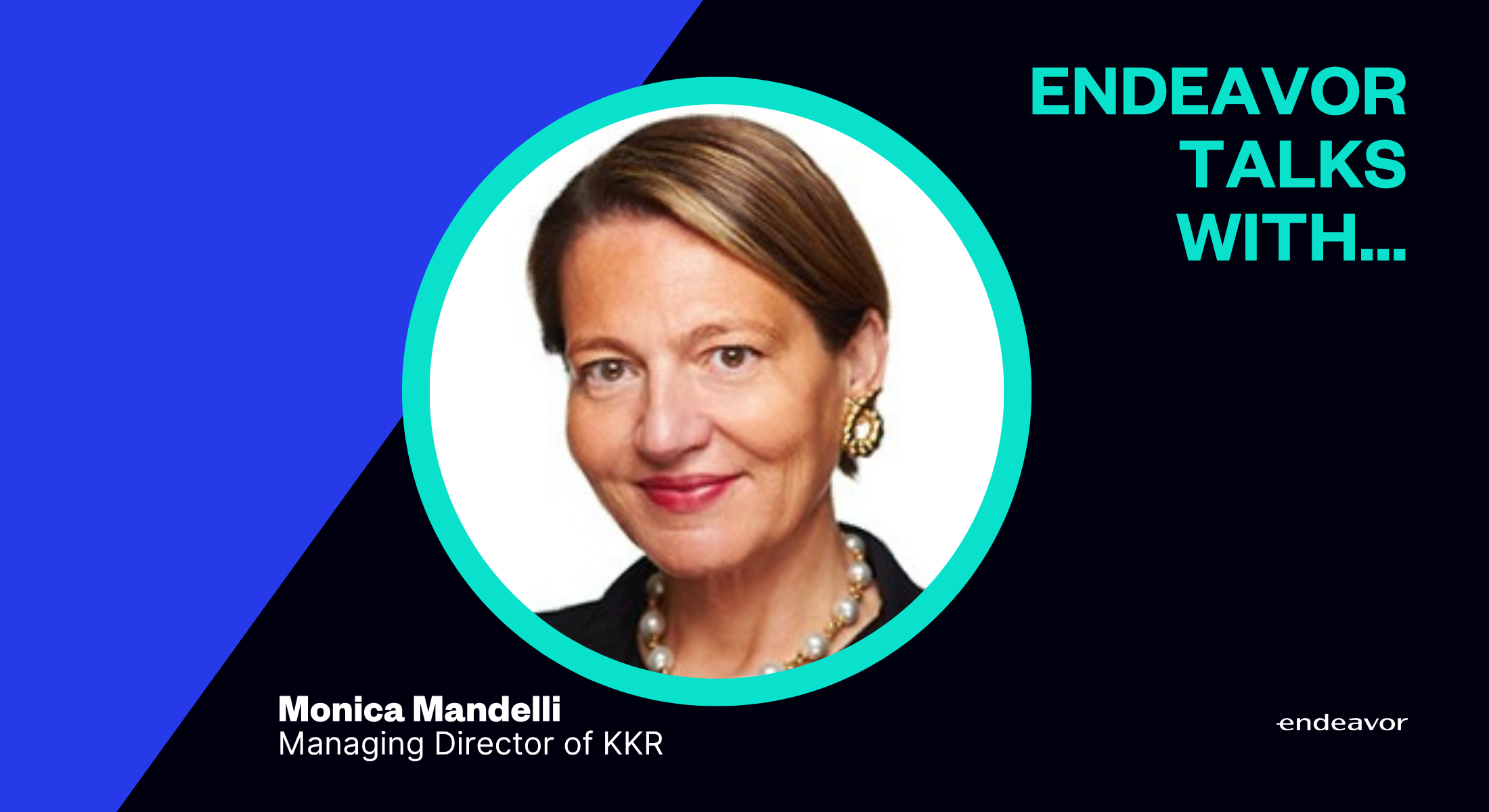
A chat with Monica Mandelli, Vice-Chair of Endeavor Italy & MD of KKR
Welcome back to Endeavor Talks With…!
This time we sat down with Monica Mandelli, New York-based Vice-Chair of Endeavor Italy and Managing Director at KKR, who was also knighted by the President of Italy as “Cavaliere della Repubblica,” the highest honor bestowed by the Italian Republic.
Happy reading!
1) WHEN DID YOU FIRST HEAR ABOUT ENDEAVOR?
It was more than 10 years ago. I was introduced to Endeavor’s founder and CEO, Linda Rottenberg. I was immediately impressed by her incredible energy and fell in love with her cause. The idea of supporting companies that make a positive difference in their social contexts was extremely interesting to me. I soon got involved as a panelist in the International Selection Panels.
2) AT THAT TIME, THERE WERE VERY FEW ITALIANS IN ENDEAVOR. MAYBE APART FROM YOU, ONLY DIEGO PIACENTINI. WAS IT YOU WHO INITIALLY PUSHED TO BRING THE ORGANIZATION TO ITALY? HOW WAS YOUR MEETING WITH THE REST OF THE BOARD, IN PARTICULAR WITH PIETRO SELLA, WHO BECAME THE CHAIRMAN?
I am very proud to have contributed to bringing Endeavor to Italy. I remember very well that one afternoon in New York I was in the car with Linda. She had just launched Endeavor Greece and Endeavor Spain, and I said to her: “Why don’t we start Endeavor in Italy too? It would be such an impactful game changer in the Italian ecosystem!” Living in New York, I couldn’t be present on the ground in Italy in a consistent way, so we needed to find a great leader who could chair the board. We were very lucky to find Pietro Sella, who is an exceptional leader and the best possible Chairman for our board. It was an honor for me to be elected Vice-Chair.
From then on, we worked hard to find all the other board members, some of whom I already knew well, like Diego Piacentini, a fellow Bocconi alumnus living in the United States like me, or Alessandro Fracassi, who was studying at MIT when I was studying at Harvard. I am delighted to say that we have assembled an extraordinary Board. I admire all my fellow board members, not only because they are incredibly successful business leaders, but also because they are wonderful people of great sensitivity and humanity.
3) WHERE DO ENDEAVOR AND ‘YOUR WORLD’ MEET?
I worked at Goldman Sachs in New York as an investment banker for 15 years, advising large companies on mergers and acquisitions, IPOs, and other financings. The companies that are part of Endeavor are obviously smaller than the ones I worked with as an investment banker, but they face similar important issues and have similar needs. Now that I’m at KKR, one of the world’s largest alternative investment firms, I’m even more aligned with what the Endeavor companies aspire to. To me, a big appeal of Endeavor is the idea of helping companies grow and achieve their greatest potential by providing ideas, strategic advice, and capital.
4) WHAT DO YOU ASSESS IN A COMPANY WHEN YOU MEET IT FOR THE FIRST TIME?
When I assess a new company, I start by focusing on 2 macro factors: vision and execution. By vision I mean, very broadly, does the business idea make sense? Is the business model resilient? Are the fundamentals sound? If the idea does not have a clear model for success from the beginning, you can be a very good entrepreneur, but you will not succeed. The second important pillar is execution. Is the entrepreneur able to realize the vision? Are they able to articulate that vision and build a team with the right skills to make the business a success? Is the strategic plan clear and actionable?
5) SO THIS IS WHAT MAKES THE DIFFERENCE BETWEEN A SUCCESSFUL START-UP AND A FAILING ONE?
If you have a potentially profitable vision and a management team that can execute, why can’t you make a breakthrough? This is where Endeavor can add so much value.
It takes humility on the part of the entrepreneur to realize that sometimes the person who takes the company from 0 to 100 is not the best person to take it from 100 to 1,000, or maybe that person simply needs a lot of help to get there.
Endeavor can provide tremendous help in turbocharging a company and taking it to the next level. There are entrepreneurs who are naturally very wide-ranging and are able to start a company from the ground up and lead it to become a multibillion-dollar operation. But those are the exception. In most cases, a great entrepreneur starts a company and grows it to a point, maybe making it a local champion. At that point, the entrepreneur has to have the courage to maximize the potential of the business for the next phase by making bold decisions. Maybe the company needs to find a partner to go global, or find a new CEO with more international experience, or raise capital to capture the opportunity… Endeavor is in the trenches with the entrepreneur, helping with these crucial matters.
6) DOES IT TAKE DIFFERENT SKILLS TO LAUNCH AND GROW A COMPANY?
Absolutely. In order to launch a business, you have to be a visionary, a leader, a jack-of-all-trades who can handle anything. It’s a very different skill set from the growth phase, where, in addition to being a visionary leader, you also have to be a great manager who can institutionalize the business.
7) WHAT WAS YOUR BIGGEST MISTAKE?
When I look back on my life and career, I don’t see one glaring strategic mistake from which I had to redeem myself. But when it comes to one’s career path, we all make small tactical mistakes along the way. The most important thing to me is to try not to make the same mistake twice. You make a mistake, you learn from it, and you move on. As for me, perhaps the mistake I made at the beginning of my career was not self-advocating, not asking enough for myself. For example, in my early years in investment banking, I would sit at my desk late into the night to finish a presentation. I wanted it to be perfect, thinking that excellent work would automatically be recognized. But I have learned that this is not always the case, and that it is incredibly important to ensure that your contribution is acknowledged and rewarded.
8) WHAT DO YOU CONSIDER YOUR GREATEST SUCCESS?
I say this with great passion: my greatest success has been reconciling a big family and a big career, because it is so difficult. It is difficult for everyone, but particularly for a woman. There is somehow a cultural bias, or a generally accepted narrative, according to which it is not possible for a woman to “have it all,” a great career and a great family, if she so wants. There is this misconception that you must always sacrifice something: for example, if you want a very intense career, you cannot have many children or must have a stay-at-home spouse; if you want 3 children, a working husband, and a dog, you have to stop working or work part-time…
The most important message I want to convey to women, but frankly also to men, is that this narrative is not true. I am a firm believer that “you can have it all,” whatever your definition of “all” is. First, you have to decide what “all” is for you, because it is different for each of us, and then you pursue it relentlessly. It is possible. It takes great organization, great support from the people around you, and huge personal commitment… but you can do it. I would like to be viewed as a role model in that sense, if it is helpful to anyone. If I did it, I can assure you that there are millions of women (and men) in Italy who can do it too.
9) DO YOU HAVE ANY PRACTICAL ADVICE ON THIS?
I have 3. One, be incredibly organized. The disadvantage of pursuing a career and a family is that you can’t improvise too much; you need a very precise schedule. Two, have a partner who is truly supportive, not just theoretically but in practice, by helping with the kids, taking on chores, and being a real cheerleader for your successes. In short, you have to choose the right person. Three, don’t sweat the small stuff. At the beginning, I thought I could be “super” at everything, that I had to be there for the smallest things. For example, I thought every morning I would pick the clothes my children would wear to school. I soon realized it was impossible; I had no time for that. In the morning I had to get ready and go to the office early for my first meeting, so I gave my kids some general directions on color pairing and let them figure it out. That fostered my kids’ independent thinking and forced me to let go of something that, in the grand scheme of things, is not so important.
10) WHY DOES THIS FAMILY/CAREER DICHOTOMY STILL PERSIST FOR WOMEN? WHAT CAN WE DO TO OVERCOME IT?
This is such a huge topic. For one, at a macro level, we should make it practically easier for women to pursue a career by providing more support with family care. That means greater access to daycare, nursery schools, family services… Women need to know that their children are well taken care of in order to focus on their work. Additionally, we still need to work on eliminating some cultural biases. We should change the still pervasive perception that in a traditional family the man is always the “breadwinner,” while the woman is responsible for managing the home and caring for the children. While this is clearly an option, it is not the only one. A woman can be the “breadwinner” too. Men and women can be true partners and share equally the responsibilities of generating revenue and managing the household.
11) DOES THIS VARY FROM COUNTRY TO COUNTRY? IN AMERICA, FOR EXAMPLE, ARE THINGS BETTER?
I think that in countries like Italy the bias is unfortunately more deeply rooted. My perception is that America is much further ahead in achieving gender equity. Clearly there are still biases, but women participate in the workforce in a much greater percentage at all levels, the concept of being a “career woman” is generally more accepted, and women more intentionally seek the freedom that comes from financial independence.
A message I want to give to women is: please start a career and keep at it. Don’t give up.
We must increase the number of women who enter the workforce, but we also must create a critical mass at the higher levels, in middle management and top management. I think this is fundamental for economic and social progress. It would benefit women and men alike. I think it is important to change the conversation and involve men as partners and allies. Gender equity is positive for everyone.
12) AFTER SO MANY YEARS OF MEETING ENTREPRENEURS, DON’T YOU EVER FEEL LIKE DROPPING EVERYTHING AND CREATING YOUR OWN COMPANY?
I have thought about it, but I have not felt that calling. The truth is I have been very fortunate to be a business builder and an entrepreneur within the large firms I have worked at. At various points in my career, I have started new businesses and found that exciting and rewarding.
13) WHAT DID THE COVID-19 CRISIS TEACH YOU?
COVID-19 has taught me so many things about myself and about business. The most important lesson on a personal level is to be grateful. We are so focused on achieving our goals and managing our complex day-to-day demands that sometimes we forget to stop and reflect on what we have: our life, our family, our work. I am grateful for the wonderful life I have, all the opportunities I have been given, and all the great opportunities still in front of me. On a business level, the most important lesson is the extreme importance of being flexible and agile. In the face of incredible adversity, it is essential to pivot and change course quickly, and to try to adapt to the new situation. The moment you get stuck doing things the same way, you fail. COVID-19 reminded us of that.