A chat with Andrea Scotti Calderini, Co-founder & CEO of Freeda
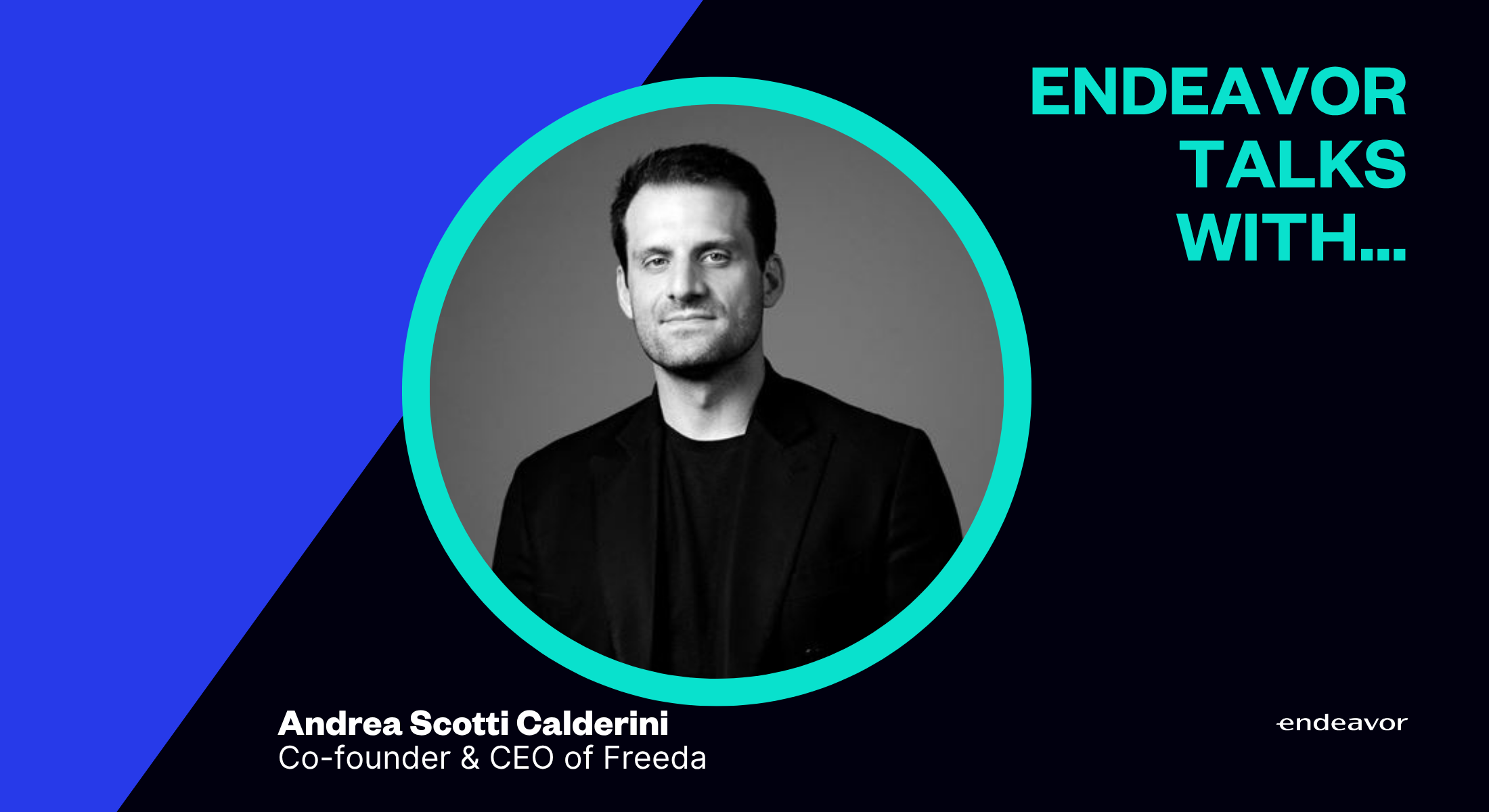
Welcome back to Endeavor Talks With…!
This time we sat down with Andrea Scotti Calderini, Co-founder & CEO of Freeda Media, the #1 media brand for entire generations of women, which inspires, represents, and speaks to them through unique content.
Happy reading!
1) TELL US ABOUT YOURSELF: WHERE ARE YOU FROM, WHAT IS YOUR BACKGROUND?
I have always been a big fan of media and creativity. I started working very early, mainly in talent management across various sectors, from art to entertainment to sports. I was lucky enough to work with Australian manager David Brown, who managed Naomi Campbell, Monica Bellucci, Roberto Bolle… From him I learned work ethic and the right approach to building an artistic career. After this experience, which I cherish with all my heart, I went on to Fremantle Media, where I was in charge of successfully intertwining creative and marketing decisions, and then branded content and content marketing for TV shows like X Factor and Got Talent. There I learned about the crossover between creativity, marketing, and branding. After 4 years, I moved to Mediaset Publitalia, where I headed the special initiatives department, again working on branded content, with the big TV networks and the big authors of Mediaset. In September 2016, I founded Freeda, my editorial project.
2) FREEDA IS THE COMPANY WITH WHICH YOU JOINED ENDEAVOR. HOW DID IT COME ABOUT, AND WHAT WAS THE SPARK THAT CONVINCED YOU TO THROW YOURSELF INTO THIS VENTURE?
Freeda was created from the observation that traditional media lacked, and still lack, representation for the new generations. This was especially evident with regard to the female world, which is where we chose to start. Over these first 5 years, we have extended our voice to an increasingly diverse audience, one that is defined less and less by gender.
3) FREEDA IS BUILDING AN ALTERNATIVE BUSINESS MODEL IN A SECTOR THAT IS CURRENTLY IN CRISIS AND TRADITIONALLY RESISTANT TO INNOVATION: PUBLISHING. WHAT HAS BEEN THE KEY?
The solution can be summed up in 3 words: listening, curiosity, courage. We started by listening to the users, to the people we want to talk about and represent. We asked ourselves how we could build a brand with a positive impact, because the new generations want companies to take a stand on certain socio-cultural issues. To do this, we invested in technology and marketing skills from day one, so that we could create content that addressed specific interests and needs. Then we chose not to have a website and to remain solely on social platforms, something that at first was incomprehensible to most. Everything started from listening.
Then curiosity, because in my opinion you can’t really invent anything: you have to look outside your comfort zone and be inspired by others, changing the 3% that makes the product uniquely yours.
In my opinion you can’t really invent anything: you have to look outside your comfort zone and be inspired by others, changing the 3% that makes the product uniquely yours.
Finally, courage: no one will tell you before you set off that this is the right choice. You have to throw yourself into it, and you have to learn faster than you make mistakes. If I could add a fourth point, I would say people: the selection of talent has been crucial.
4) EARLY IN THE JOURNEY, HOW DID YOU GET INVESTORS TO TRUST YOU? WHAT WERE YOUR STRENGTHS?
Reality has its limits and boundaries, but the world of imagination doesn’t.
You have to work on that: imagine, and then present what you’ve imagined with professionalism and enthusiasm, because that has a very strong persuasive power.
It was also crucial that my co-founder Gianluigi Casole, the people we brought with us at the beginning, and I all had rich personal and professional backgrounds, and the union of these experiences gave us strength. It is also important to find people with the same interests and courage that we had. Our first investors were Lorenzo Mieli and Mario Gianani, two of the most famous Italian television and film producers, and Ginevra Elkann, a person with great artistic and editorial skills.
5) AT THIS STAGE, FREEDA IS DIVERSIFYING ITS BUSINESS WITH A SOCIAL BRANDING PLATFORM. CAN YOU TELL US MORE?
Freeda Media was founded on branded content, that is, creating the best possible content to build a connection between brands and the younger generation. At some point, Michelle Hunziker and Artszana asked us to help them create a new brand, Goovi, with a platform based on Freeda’s model. In 3 years, Goovi has become one of the biggest success stories in cosmetics in Italy, thanks also to the community we created, with a very relevant value universe.
From that point on, more and more companies, brands, and industrial groups started asking us to help with their platforms, and very interesting partnerships arose. In the end, we realized we needed to create a marketing and engagement platform, Freeda Platform, in which branded content is embedded alongside other activities: listen, i.e. optimizing media impact and social content; engage, i.e. data and creativity; and trans-act, i.e. the e-commerce part.
6) WHAT SHOULD BE IN THE “TOOLBOX” OF SOMEONE WHO WANTS TO LAUNCH A START-UP?
Courage. We are returning after 2 very complicated years, on a personal and professional level, so launching a new project requires courage. The second thing is a lot of determination. Michelangelo said something wonderful, which I will paraphrase: “If people knew how much work there is behind what I do, they would consider me much less of a genius.” Often the entrepreneur is celebrated as a “genius,” but the truth is that those who are in it know it requires a lot, on a physical, mental, and relational level.
7) WHAT MAKES THE DIFFERENCE BETWEEN A SUCCESSFUL START-UP AND A FAILED ONE?
Determination and hard work.
Work-life balance is a very important issue, and it’s your duty as an entrepreneur to guarantee it to your workforce, who need to feel good, grow well within the company, and find the right fit.
But, I’m sorry to say, for entrepreneurs or managers of a certain level, the same doesn’t apply.
Often a start-up is set up with one business model in mind and it changes along the way, so hard work allows you to steer the ship and bring it safely and successfully to port.
8) HOW DO YOU CHOOSE WHO WORKS FOR YOU? WHAT QUALITIES DO YOU THINK ARE IMPORTANT IN TODAY’S BUSINESS WORLD?
Freeda is a company where being aligned culturally and on our values is paramount. How a person conducts themselves in the work environment is more important than any academic title. We look for people who are empathetic, who can look at things from multiple perspectives, who are collaborative, and who talk about “us” and not “me.” They must want to express themselves, because Freeda is diverse and inclusive, not only in what it does but also within the team, which has more than 20 nationalities. We are looking for ambitious and courageous people who want to look beyond, make mistakes and learn from them, and give and receive feedback very openly.
9) LET’S TALK ABOUT MISTAKES: WHAT MISTAKES DID YOU MAKE AND WHAT DID YOU LEARN?
I’ve made a lot of them, and it’s because of the mistakes that we’ve gotten this far. At the beginning of my career I did almost everything on my own; I fell in love with my ideas and wanted them carried out exactly as I said. Now I’m much more open-minded. I listen to other people’s opinions, and the projects benefit from that. Another mistake was not prioritizing: being an enthusiast by nature, I often brought too many ideas to the table, too much stimulation, and this is never good, because for a company to succeed you need to focus on well-defined goals. I’ve also learned to be more thoughtful. If I see something that doesn’t work in the office, I take some time to think about it calmly and come up with a solution, whereas before I was more reactive, even short-tempered. These mistakes are all part of my journey of maturity, thanks to which I am becoming, I hope, a better entrepreneur and a better man.
10) WHAT HAS YOUR EXPERIENCE WITH ENDEAVOR BEEN LIKE?
The selection process at Endeavor, especially the last phase, was really interesting. Entrepreneurs look for a challenge, a confrontation, because it motivates you and validates your ideas, and Endeavor’s selection process allowed us to confront entrepreneurs who had already seen and done things we had not yet seen or done. It was a very valuable process, and I would recommend it to any company, young or established. The relationship is also great: Endeavor has always supported us when we needed it.
11) ENDEAVOR CARES DEEPLY ABOUT THE GENDER GAP IN THE PROFESSIONAL WORLD, ESPECIALLY IN BUSINESS, AND WE OFTEN ASK WOMEN WHO HAVE MADE IT TO OFFER ADVICE TO YOUNG WOMEN WHO WANT TO FOLLOW IN THEIR FOOTSTEPS. WE WANT TO ASK YOU: WHAT SHOULD ENTREPRENEURS DO TO CREATE TRULY INCLUSIVE ENVIRONMENTS, AND HOW CAN THEY BE “ALLIES” TO WOMEN IN THE WORKPLACE?
In a way, you’re asking the wrong person, because for me it’s very natural. I have been investing in women since day one, both because of a bias of mine (I’ve always worked better with them) and because I believe in the strength of women at work. 75% of our team are women: the 3 country managers and the general manager of the platform are women, as are most of the other teams. The reason all entrepreneurs should do the same is simple: not doing so leads to less success, greater dissatisfaction, and lower results. It’s proven that a work environment where women and men have equal opportunities brings more happiness and satisfaction to everyone, personally and for the company.
I repeat “happiness” because it’s something concrete: families in which women are as fulfilled as men are more serene and more balanced. Fostering diversity is not only fair, but also profitable for companies and the economy in general.
The other thing that is very important, and I say it because I truly care and believe it, is that women should not be afraid. Sheryl Sandberg also teaches us that in her first book, Lean In, which I love. At one point, Sandberg tells the story of having very strong and well-prepared female colleagues who, instead of sitting at the table, would sit in chairs to the side, effectively self-exiling themselves. It reminds me of school exams: if you asked a boy how he did, he would answer “very well!” even if he had done just enough, while if you asked a girl, she would answer “I could have done better.” Society still experiences inequality, and unfortunately COVID-19 has highlighted this, which is why I would like women to be as shameless as men at work, valuing their skills rather than downplaying them. This does not detract from the efforts of men, which, as I said, must be included.
12) WHAT BOOK WOULD YOU RECOMMEND FOR SOMEONE WITH A BUSINESS TO GROW?
There’s one book that has been instrumental for me; I’ve read it 5 times: Ben Horowitz’s The Hard Thing About Hard Things. In the first 80 pages, he describes the effort he went through to build Netscape. I read it before I started Freeda and also during, because it gives you a sense of what it really means to run a business.