A chat with Fabio Troiani, Founder & former CEO of BiP
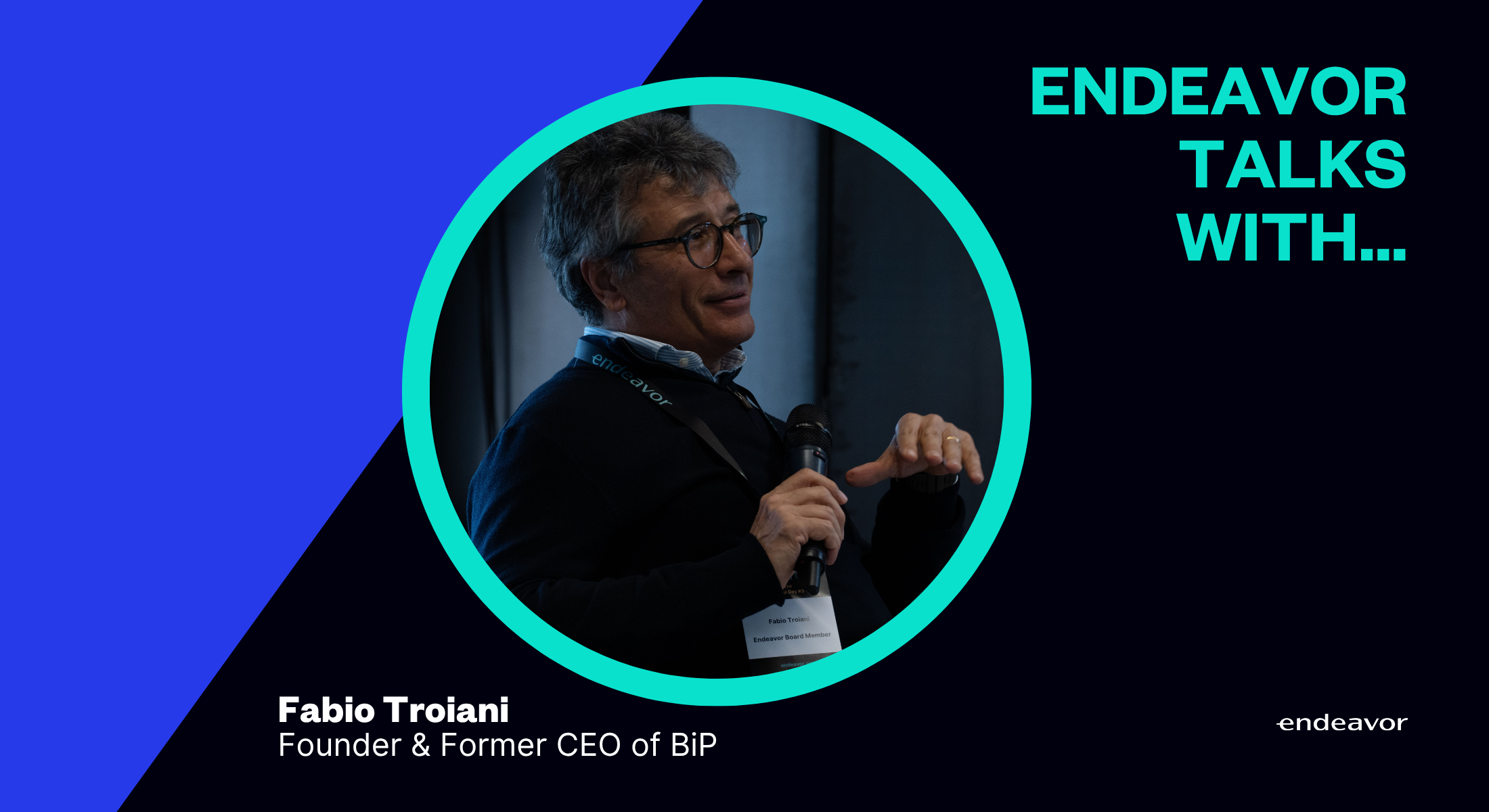
Welcome back to Endeavor Talks With…!
This time we sat down with Fabio Troiani, Endeavor Italy Board Member, digital entrepreneur, and former Founder & CEO of BiP.
Happy reading!
1) WHEN DID YOU FIRST HEAR ABOUT ENDEAVOR?
I was first told about it by an Endeavor Mentor who had been on a sort of ‘educational trip’ to Silicon Valley, to Stanford, for members of the network. I found out that there were people on the Italian Board I have a lot of respect for, and I asked them for more information. That’s what convinced me the initiative was something unique, and I decided I wanted to be part of it.
2) WHAT CONVINCED YOU ABOUT ENDEAVOR COMPARED TO OTHER ORGANIZATIONS?
The idea of entrepreneurial give-back: supporting deserving entrepreneurs by donating not only money, but especially time. I say especially because donating money, if you have any, is relatively ‘simple’. Donating time and passion is more complicated, but also more important.
3) WHAT DO YOU VALUE IN A COMPANY WHEN YOU FIRST COME ACROSS IT?
Having run a people business for more than 30 years, I value the team first, even before the mission and the company’s massive transformative purpose. In an economy like ours, which is very service-driven, people make the key difference.
It takes people with both entrepreneurial and managerial skills.
4) WHAT IS THE BIGGEST DIFFERENCE BETWEEN A SUCCESSFUL START-UP AND ONE THAT FLOPS? AND ONE THAT STAYS SOMEWHERE IN BETWEEN?
It’s a combination of factors. First, the economic environment in which the company operates. Being in a country with a healthy economy, growing demographics, and a government intent on solving some challenges makes it easier. Next, market validation cannot be overlooked.
The concept of the company has to be well designed, meaning it has to answer a question or be so innovative that it creates one. It takes people with both entrepreneurial and managerial skills.
5) CAN YOU DESCRIBE YOUR JOURNEY?
As soon as I finished university, I knew I needed work experience, which is why I later saw the point of studying for a master’s degree abroad. It was also important for me to work for large multinationals, from Olivetti to Deloitte, because it helped me understand that to create something that reflects your vision of the world, you have to be an entrepreneur, not a manager. It’s been a lifelong learning process, which also includes Endeavor, which allows me not only to help scale-ups but also to learn from them.
6) ARE THERE ANY CHARACTERISTICS THAT SET ENTREPRENEURS AND MANAGERS APART?
The entrepreneur is much more inclined to take risks, while the manager is more conservative. The downside is that the entrepreneur tends to underestimate the complexities of management, whereas the manager knows how to handle them. For this reason, they are two people who must learn from each other.
7) WHAT DO YOU CONSIDER YOUR GREATEST ACHIEVEMENT?
I created BiP, a company that started with 60 people and had 3,600 when I left. BiP grew from a turnover of €10 million to €360 million, providing work for young people, mainly Italian but not exclusively, in a profession that is still very interesting: helping companies transform technologically and digitally.
8) AND YOUR BIGGEST MISTAKE?
Thinking that the relationship with private equity funds was the way to boost entrepreneurship. Not so much. They do boost entrepreneurship, yes, but a majority deal puts the fund in a position of control, not support, and this risks suppressing entrepreneurship rather than amplifying it.
9) WHERE DO YOU FIND THE INCENTIVE TO LEAVE A COMPANY YOU’VE BEEN GROWING FOR YEARS AND EMBARK ON NEW ADVENTURES?
Sociologist William Bygrave described the life of the entrepreneur as a 4-stage process: nurture, growth, development, and consolidation.
The last is the moment when your creation can stand on its own two feet, helped by the right people who can take it into a new phase. It is this confidence that gives me the freedom to start other businesses that I hope will be just as lucky.
10) WHAT HAS THE COVID-19 CRISIS TAUGHT YOU?
That you should never think of history as a straight line, believing that things will always follow the same course. Uncertainty and risk are just around the corner, and so are opportunities.
11) HOW IMPORTANT IS WORK-LIFE BALANCE TO YOU?
It is absolutely vital. One of the benefits of COVID-19 is that we have been able to work from home and, in some ways, reunite with our families. Affective bonds are critical to people’s well-being, and I include all types of family, and even circles of friends. A good emotional environment keeps people more balanced, and when someone is balanced, they are also balanced at work. I have always been concerned about people who spend too many hours at work, as if they have no other attachments or interests.
To me, this is a serious limitation of human “roundness,” and when you have to manage people, that gap is noticeable. Since the economy is now focused on the tertiary sector, being able to read people is fundamental, and this ability can only come from a healthy social life, which must be given the right amount of time to flourish.
12) WHY DO YOU THINK A COMPANY LIKE ENDEAVOR IS IMPORTANT IN OUR COUNTRY?
Because it allows entrepreneurs to engage with the global business world, and there is a desperate need for this in Italy.