A chat with Danila De Stefano, CEO & Co-founder of Unobravo (now also Endeavor Italy Board Member)
Welcome back to Endeavor Talks With…!
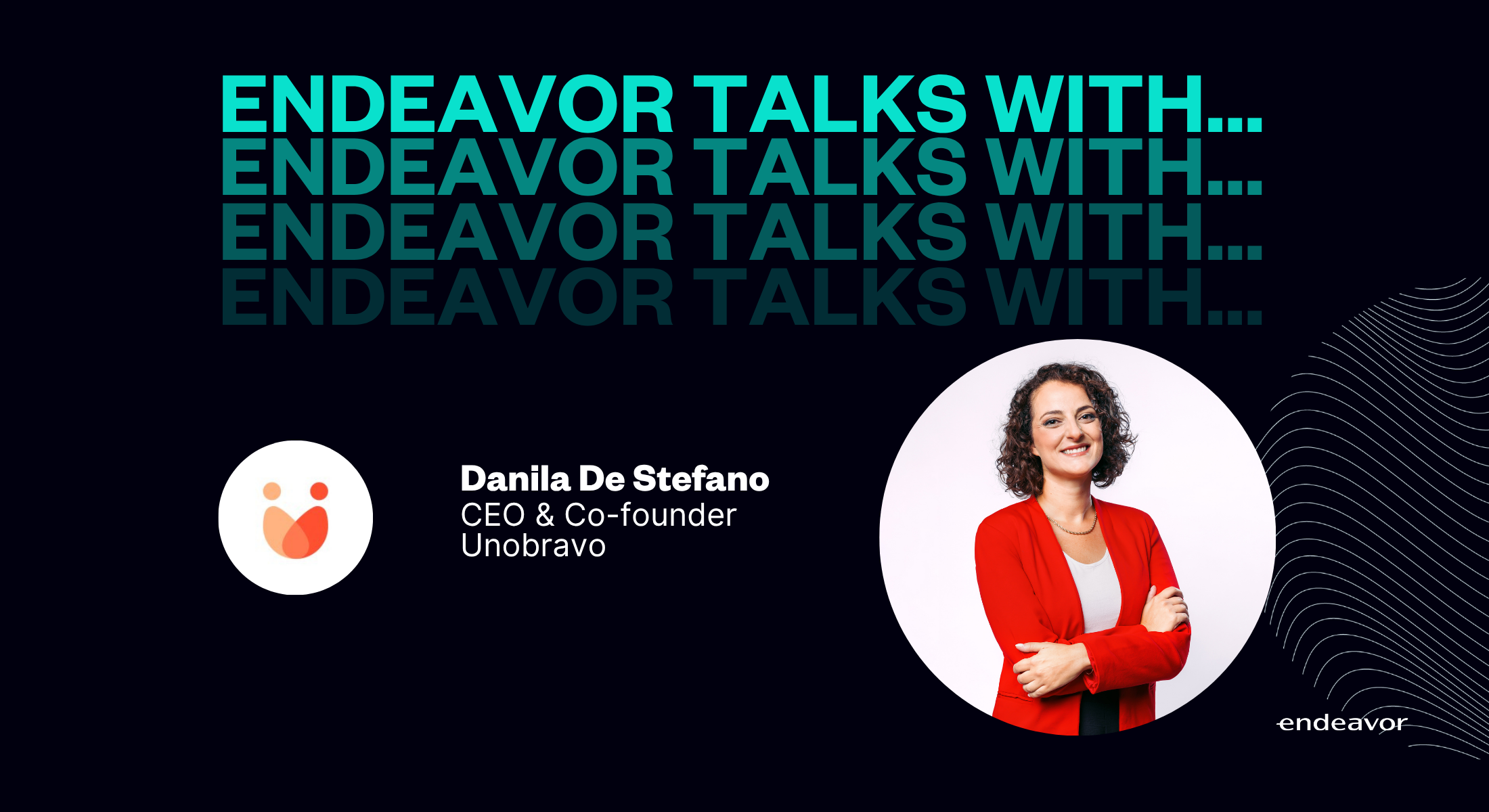
This time we sat down with Danila De Stefano, Co-Founder & CEO of Unobravo, Italy’s leading online mental health platform, and Endeavor Italy’s newest Board Member.
Unobravo connects people with licensed therapists online, making psychological support more accessible, affordable, and stigma-free. Since its founding, the platform has grown to over 9,000 clinicians and has become a reference point in Italy’s mental health landscape. Danila has been part of the Endeavor network since 2021, first as an Elevator participant, then as an Endeavor Entrepreneur, then as an Outlier. Today, she joins the Board: the first Italian entrepreneur to make this journey from the ecosystem to the table where decisions are made.
Happy reading!
1) Unobravo was born from a personal experience: your own struggle to find psychological support while living in London. How much does it matter, for a high-impact entrepreneur, to have felt the problem you’re solving firsthand?
Being able to relate to the problem you’re solving matters enormously. When I was in London trying to find a therapist in my language, one I could actually afford on an expat trainee budget, I kept hitting walls. Language barriers, endless waiting lists, costs I couldn’t justify. That frustration wasn’t just the spark. It showed me exactly what “good enough” wasn’t, because I’d lived it. And being a therapist myself meant I didn’t just feel the problem as a user: I had very strong opinions about what a real solution would need to look like.
That said, I think what truly matters is the depth of your relationship with the problem, not necessarily that you’ve experienced it personally. Some of the best entrepreneurs I know became obsessed with a problem by being close to people who lived it. What doesn’t work is building at arm’s length, driven only by market size. Genuine empathy, however it was earned, is what keeps you honest when the easy shortcuts start looking tempting.
2) You waited three years before raising your first external round, reaching break-even on your own. In an ecosystem that often treats fundraising as a milestone in itself, what gave you the confidence that was the right call?
The model was working. Unit economics were solidly profitable, and we could see it clearly. Bringing in external capital at that point wouldn’t have added acceleration. It would have just diluted the cap table for no real reason.
What I’d actually encourage founders to do is understand the dynamics of their own company deeply before anything else. Every company is different.
People were pushing me hard to raise a round I didn’t need. If I’d listened, the situation today would look very different.
3) Going from 0 to 9,000+ clinicians while maintaining high clinical standards is a serious operational challenge. How did you build a quality and selection system that actually scales — and where did you have to fail first to figure it out?
The early failures were humbling, and in hindsight more useful than the wins. We relied too heavily on credentials at first, and learned quickly that a degree and a license tell you surprisingly little about whether someone will be an excellent therapist on our platform. We had to rethink the whole selection process: structured assessments, clinical simulations, ongoing performance feedback rather than a one-time gate.
What made it scale was accepting that quality is not a checkbox at onboarding. It’s a continuous system. We invested in clinical supervision, peer feedback loops, and patient outcome data that feed back into how we support and, when necessary, offboard clinicians. Most of this infrastructure was built reactively: a problem would surface, we’d diagnose it, then build the system that would have prevented it. That’s not elegant, but it’s how you build something genuinely fit for purpose.
4) Unobravo isn’t just selling therapy sessions, it’s also fighting a deep cultural stigma. How do you change collective perception around mental health through a private company, and where do you feel there’s still the most ground to cover?
A company like Unobravo can normalize a behavior through repetition at scale. Every person who books a first session, has a good experience, and tells a friend is doing more for destigmatization than any awareness campaign. We’ve tried to build the product so that starting therapy feels low-stakes and private. No waiting room, no receptionist, no commute, no one to run into. Reducing friction is itself a form of cultural work.
There’s still the most ground to cover in two areas: men and the workplace. As we showed with our recent campaign “Unobravo for Men” during Mental Health Awareness Month, there’s a generation raised with a very specific idea of what ‘handling things on your own’ means, and that’s still hard to shift. Unobravo for Men was a provocative campaign aimed at breaking gender stigmas. On the workplace side, what frustrates me is the gap between rhetoric and reality. Everyone is a mental health ally in theory. Then a public figure shows vulnerability, an athlete breaks down, and suddenly it becomes a personal failing, something to judge rather than understand. Companies talk about mental health constantly and then create cultures where no one feels safe admitting they’re struggling. We’ve partnered with some of Italy’s largest organizations, from Poste Italiane to Costa Crociere, reaching over 300,000 employees, but the cultural gap between what organizations say and what they actually resource is still enormous. That’s the next frontier, and it requires both private and public sectors to close it together.
5) You’re joining Endeavor’s Board after being supported as an entrepreneur yourself. What do you bring to the table and what do you expect to learn from this new vantage point?
What I hope to bring is a recent, unvarnished memory of what it actually feels like to build. Not the retrospective version where everything was harder yet cleaner; but rather, the real-time confusion of making consequential decisions with incomplete information while managing a team, a board, and your own doubts. I want to be the person in the room who keeps pulling conversations back to what the founder in front of us actually needs right now, not what we think we’d need if we were them.
But more concretely: I already work with founders outside of any formal structure. I’ve spent years building community and initiatives that create spaces where founders talk to each other, not just to mentors. Peer exchange, at the right moment, is often worth more than advice. That’s something I understand well and want to bring directly into Endeavor’s work at a larger scale.
You have to put yourself in rooms where you’re not the expert.
What I expect to learn is harder to define precisely, and that’s exactly why it interests me. Sitting on this Board means exposure to a much wider range of trajectories, markets, and moments than any single company can offer. My pattern recognition has been built inside one context, one industry, one specific growth curve. I’m genuinely curious to see how much of what I think I know holds up when I’m looking at twenty different companies instead of one. That kind of stretching is something I actively look for, and I don’t think you can manufacture it.
6) YOU HAVE BEEN AN ENDEAVOR ENTREPRENEUR LONG BEFORE JOINING THE BOARD — and over the years you’ve become a go-to reference for founders just starting out. What changes in the way you support someone at the beginning, when you know firsthand exactly what it feels like to be in that moment?
The honest answer is that having lived it changes everything, but not in the way people might expect. It’s not that I’m softer or more empathetic in some abstract sense. If anything, I’ve become more direct. I spent years finding my way to certain conclusions that, in hindsight, someone could have helped me reach faster. That shapes how I show up now.
When I see a founder circling around something they already know but aren’t ready to say out loud, I name it. Not because I enjoy the discomfort, but because I remember what it cost me not to have someone do that for me sooner.
The thing I’ve had to work hardest against is the temptation to over-apply my own experience. The pull is strong: you went through something similar, you know what worked, and it’s faster to just say it. But the founder in front of you is not you, their company is not your company, and the moment is not your moment. My experience is one data point, not a template. What I try to do is bring the directness and the urgency, and then ask enough questions to make sure the conclusion they reach is truly theirs.