A chat with Renato Panesi, Co-founder & CCO of D-Orbit
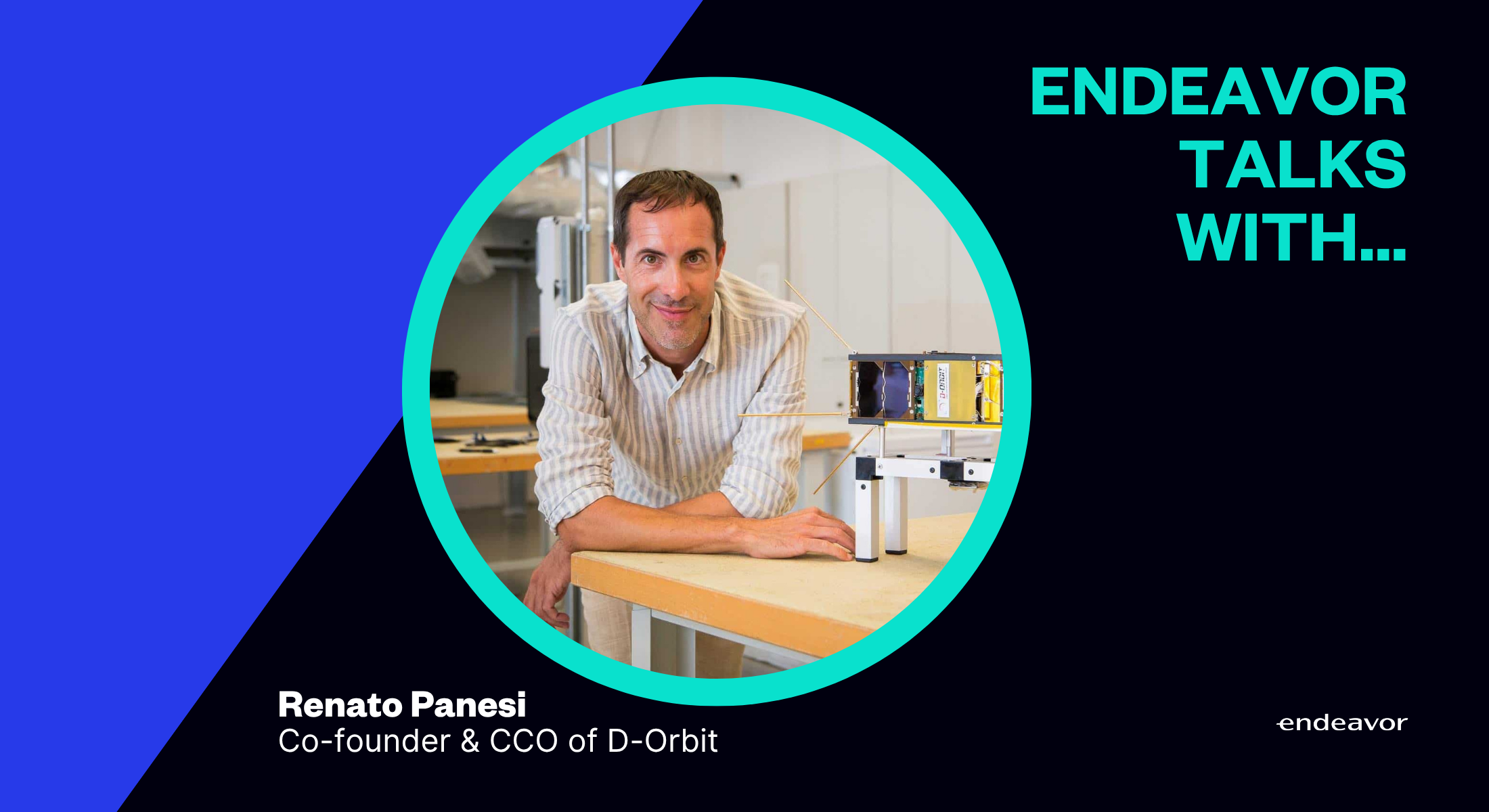
Welcome back to Endeavor Talks With…!
This time, we sat down with Renato Panesi, Co-founder & CCO of D-Orbit, a New Space company with solutions covering the entire lifecycle of a space mission, including mission analysis and design, engineering, manufacturing, integration, testing, launch, and end-of-life decommissioning.
Happy reading!
1) TELL US ABOUT YOURSELF: WHAT IS YOUR BACKGROUND?
You don’t become an aerospace engineer by accident: it’s a passion I’ve nurtured since I was a child. I have a degree in aerospace engineering and a PhD in advanced control systems, which I pursued while working in the research and development division of Leonardo, at that time Finmeccanica. As I was about to submit my thesis, I came across a call for a 6-month internship at a Silicon Valley start-up, with a course at Santa Clara University. It was at the oral session of the selection process that I met Luca. In the end, we were both chosen, and so we found ourselves in San Francisco: you could say that everything started from there. Since VC investors at that time were not looking at aerospace, which was still seen as a public sector instead of a start-up, we ended up doing our internship at the NASA Research Center. During this journey, Luca and I decided to merge our projects, and D-Orbit was born.
2) ONE MIGHT WONDER WHY YOU DIDN’T STAY IN THE UNITED STATES.
We didn’t even think about it. We knew we wanted to set up our company in Italy. In part it was a decision made for personal reasons, but above all we knew that here we would find the right competencies, skills, and network of suppliers and partners. And it was a winning bet, because we built a team of excellent people. Upstream activity, that is, building and launching satellites, is still unknown to the general public, so people don’t know how great Italy’s tradition is in this sector.
Italy was the first country, after the United States and the Soviet Union, to launch a satellite. It has central know-how and patents, and its academic training is also of the highest level.
3) BUT NOW YOU HAVE A TEAM OF MORE THAN 100 PEOPLE. HAVE YOU GONE INTERNATIONAL?
Of course. In fact, it’s a source of pride for us: it’s rare for specialized professionals to come and work in Italy, but we have Americans, Dutch, English, French, Swiss, Greeks, Spaniards… It’s very nice. But we started from a strong, creative core with incredible problem-solving skills even in the face of economic constraints, and these are typically Italian talents.
4) WHAT IS A PARTICULAR MEMORY FROM THE EARLY STAGE?
There was a moment, in 2013, when we had to close a second round of investment, but it took a long time. The problem was that we had to carry out the first launch; skipping it would have meant waiting 2 or 3 years to try again, and we had €2,000 in the company’s account. So our employees paid out of their own pockets for the components needed to launch in time. Needless to say, we were moved. Then the investment arrived, and they were reimbursed and rewarded, but they did it all without us asking for anything, because they felt they were part of something special. At that moment we realized we had made the right choice by staying here: I can’t see an American team, for example, doing the same.
5) WHAT SHOULD BE IN THE “TOOLBOX” OF THOSE WHO WANT TO LAUNCH A DEEP-TECH START-UP IN ITALY?
Some aspects apply all over the world and to all businesses: you need a lot of tenacity, a lot of confidence in what you are doing, and a lot of humility.
To launch a start-up, you need a lot of tenacity, a lot of confidence in what you are doing, and a lot of humility.
I would also add dedication, because from when you start to who knows how many years later, the start-up becomes your life. If someone thinks of founding a start-up to get rich, they are not going anywhere. The future belongs to those who want to improve something, whether the world, society, or a service, and respond to needs, big or small.
6) LET’S TALK ABOUT FUNDRAISING: HOW DID YOU FIND SOMEONE WHO BELIEVED IN D-ORBIT?
If I look at our first business plan today, I have to laugh: I wouldn’t finance myself! The development part was well done (after all, we are engineers), but the financial forecast was far too optimistic, and the investors knew it. In Silicon Valley they used to tell us: 20% is the idea, 80% is the team. That’s exactly right. Our early investors focused on the skills, seriousness, and value of the team.
It must also be said that in Europe, the presence of institutions is strong. We have had development and co-financing contracts from the European Commission under the Horizon 2020 program, and from the European and Italian Space Agencies.
7) HOW DO YOU CHOOSE EMPLOYEES? WHAT QUALITIES ARE IMPORTANT IN TODAY’S WORKING WORLD?
One of the characteristics we look for, beyond technical skills of course, is flexibility. Let’s call it ‘risk appetite.’ You can’t work in a start-up without it. In addition, in our industry it’s essential that technicians and program managers are very close-knit, because they have to work with precision, trust, and cohesion. That’s why we assess very carefully whether there is a good ‘fit’ between people.
8) LET’S TALK ABOUT MISTAKES: WHICH ONES DID YOU MAKE AND WHAT DID YOU LEARN?
To be heard in our target community, we needed a track record. At the beginning, maybe we tried to fly too high, proposing our solutions to big companies that told us, “Come back when you’re ready.” We were a bit too busy with business development, meaning the search for customers and markets, when we could have spent even more time on product development.
9) WHAT HAS YOUR EXPERIENCE WITH ENDEAVOR BEEN LIKE?
Awesome.
Of the many initiatives that support start-ups and that we’ve dealt with, Endeavor is without a doubt the best.
We have received and continue to receive support on many fronts. Some of our investors are part of the network or were introduced to us by Endeavor, which has also been invaluable in gaining relevant connections in several international markets. In addition, the support we receive from our account manager is consistent and exceptional. Also, through Endeavor we have done initiatives with EY, for example, that have improved our internal processes.
A separate discussion applies to meeting opportunities, such as retreats. There are many networking opportunities, but what makes the difference here is the quality. Normally, if you’re lucky at an event, you’ll meet 1 or 2 people you can be useful to, or who will be useful to you. With Endeavor, on the other hand, it’s always worth it; we’ve never been disappointed.
10) THE SPACE ECONOMY IS A SECTOR WITH A LOT OF ACTIVITY. IN WHICH DIRECTIONS DO YOU THINK IT WILL MOVE AT A GLOBAL LEVEL, AND WHAT ROLE COULD ITALY PLAY?
Certainly, the business will continue to grow. This is a global market, more so than it was 30 years ago, partly because the reduction in costs has given access to space to countries that previously didn’t have it: Southeast Asia, the Persian Gulf countries, Latin America, and Africa will also come. There is also a geopolitical dimension, because this access is strategic. The new space race is not military; it is for commercial purposes, for autonomy and independence. Italy believes a great deal in the space economy, and the first dedicated fund, Primo Space, was recently created. Our country can play a dual role: as a member of the European Space Agency, bringing capital to develop something great together, and as an individual country, thanks to its great tradition in launches. Launch is a very important enabling factor. Avio, which builds the Vega, is one of only 2 European launchers. And in addition to launch, we are there, doing the last-mile delivery of satellites, and in the future we will do space logistics in general. Plus, there is the entire fabric of other large, small, and medium-sized companies in the sector, which boast products of excellence. Italy has what it takes to play a leading role in the evolution of the space economy.
Our limitation is that we struggle to create a system, and not only in this field. If we united the competencies of our companies and universities, perhaps coordinating at a governmental level, we could make a difference.
11) GOALS AND CHALLENGES?
Now that we’re established as a global provider of satellite launch and end-of-life removal, we’re missing in-orbit service, which we’re looking at. With a slightly more visionary eye, we’re also thinking about commercial orbiters further from Earth, dealing with moon tourism and space mining. We are looking at the birth of an economy and a market, with an increasingly global company and a strongly Italian soul.
12) FINALLY: STAR WARS OR STAR TREK?
Of course, Star Wars!