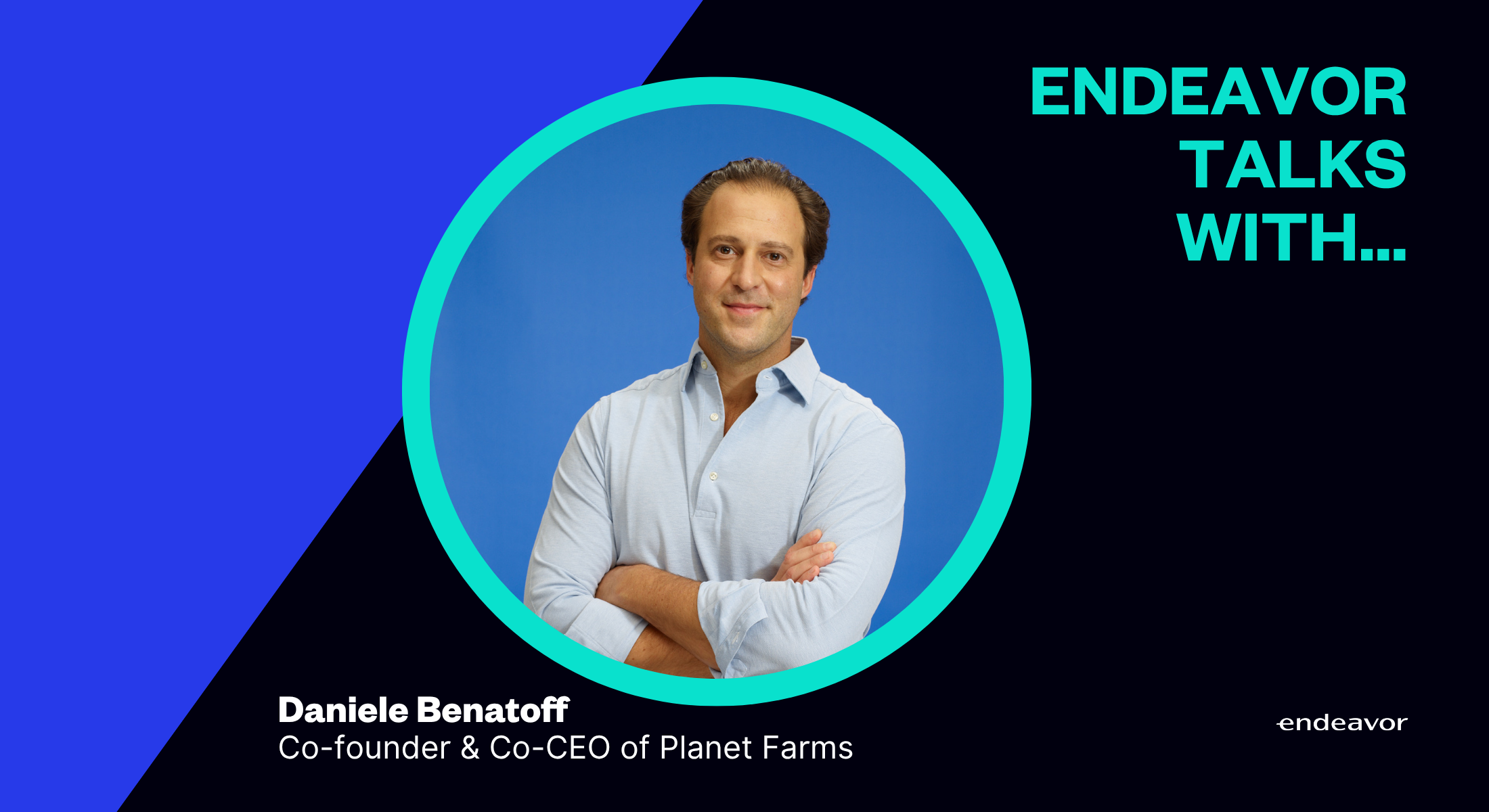
A chat with Daniele Benatoff, Co-founder & Co-CEO of Planet Farms
Welcome back to Endeavor Talks With…!
This month we had a chat with Daniele Benatoff, Co-founder & Co-CEO of Planet Farms, a leading Italian company in vertical farming. According to Daniele, “vertical farming is necessary because it is how we can imagine continuing to eat tasty, fresh food instead of pills on Mars.”
Happy reading!
1) Tell us about yourself: where do you come from, what is your background?
I was born and raised in Milan, but I left after high school to study in the United States, where I then attended the Wharton School, which introduced me to the world of finance. I spent ten years at Goldman Sachs in London, then I threw myself into my first entrepreneurial venture, a small hedge fund, which led me to manage some American funds. After 15 years, I started looking around for other business opportunities, and that’s when I reconnected with Luca, my partner in Planet Farms.
2) What was the spark that convinced you to invest in the Planet Farms venture?
It was partly a spark and partly a fire that grew slowly. Luca is a childhood friend, and I ran into him again by chance at a wedding. He was coming out of a difficult period in which he had been diagnosed with a bad illness, then fortunately recovered, while I had just become the father of my first child. In short, it was a time when we both, for several reasons, felt we wanted to give meaning, a purpose, to our lives. Becoming a father gave me another perspective, and I began to realize the impact that the present has on the future.
3) How did you know it was the right idea?
Luca comes from the world of food and became interested in vertical farming after reading a lot about it in the wake of the Fukushima disaster. He had started incubating the idea that would later become Planet Farms within his family business. When he told me about this idea, I immediately grasped its potential, not least because I’m half Israeli — a desert country, therefore at the forefront of agricultural technology — and I’m very familiar with vertical farming. Over the next few days, we kept talking about that idea; it wouldn’t leave our heads. And that enthusiasm was proof that it was the right idea.
4) What is vertical farming?
We talk about “vertical farming,” but verticality is not the differentiating aspect of what we do; it’s nothing new. The hanging gardens of Babylon were vertical, weren’t they? The real news is that it is controlled environment agriculture (CEA). Agriculture is the oldest sector in the world and has always had a fixed paradigm: I produce what I can, when I can, where I can. With our technology, it is possible to recreate the conditions of the past, with fertile soils and a stable climate, through an entirely controllable process. We can produce what you need, where you need it, 365 days a year.
5) And is it necessary?
Yes, because the world population has grown, more and more people live in cities, and we consume the same food all year round. Today, vertical farming is a niche that is heavily research- and development-driven. All this is environmentally friendly: water consumption is 95% lower and less land is consumed. One hectare of our vertical farm is equivalent to 300 hectares of traditional farmland, which means that the rest of the land can be used to recreate biodiversity. So yes, it is necessary, because it is how we can imagine continuing to eat tasty, fresh food instead of pills on Mars.
6) Have you followed particular strategies to attract the first investments?
We used our own money. If investors see that you’re putting your money into the project, they understand how much you believe in it. Then our first investors followed, and we have since been on a continuous cycle of demonstrating before attracting the funds needed to achieve the next steps.
7) Could vertical farming one day replace traditional farming?
No, and we don’t even have the ambition to do that. Ours can never be the only answer. Agriculture is a field that finds it difficult to collect data because everything takes place under conditions that are difficult to control. Instead, we generate a huge amount of data, and it is perfect data, because we control every aspect of the growing process. So, for the first time, we learn in a scientific and exponential rather than empirical way. We work with many universities to do research and development. We do not want to replace traditional agriculture, but rather support it and partner with it.
8) In recent years, there has been a lot of talk about the environmental crisis. What do you think is the position agriculture should take?
No one is touched by the environmental crisis more than farmers, which is why they really understand it and are willing to look for and embrace alternatives. The problems are many and profoundly serious, but there are possible solutions to each of them, and we still have time to implement them, so it’s not all doom and gloom. Pragmatically, our aim must be to find sustainable and scalable solutions to the most urgent problems, then work to repair the damage that has been done.
9) What should be in the ‘toolbox’ of those who want to launch a start-up?
It is necessary to communicate briefly and clearly why that company must exist. You need to be clear about your strengths and weaknesses to create a balanced team to fill any gaps. Then execution, which is made up of strategy, vision and culture, makes the difference. The latter is the most important thing.
Finally, never underestimate the importance of communication, both internal and external; nothing grows in a vacuum.
10) What was your experience with the Endeavor selection process?
It was fascinating. I have participated in many selections, and I have experienced Endeavor as a continuous and highly empathic conversation, with people who are further along the entrepreneurial path than I am. It was extremely stimulating and fun… enough to keep us up at night, since we continued some sessions until 2 a.m.!