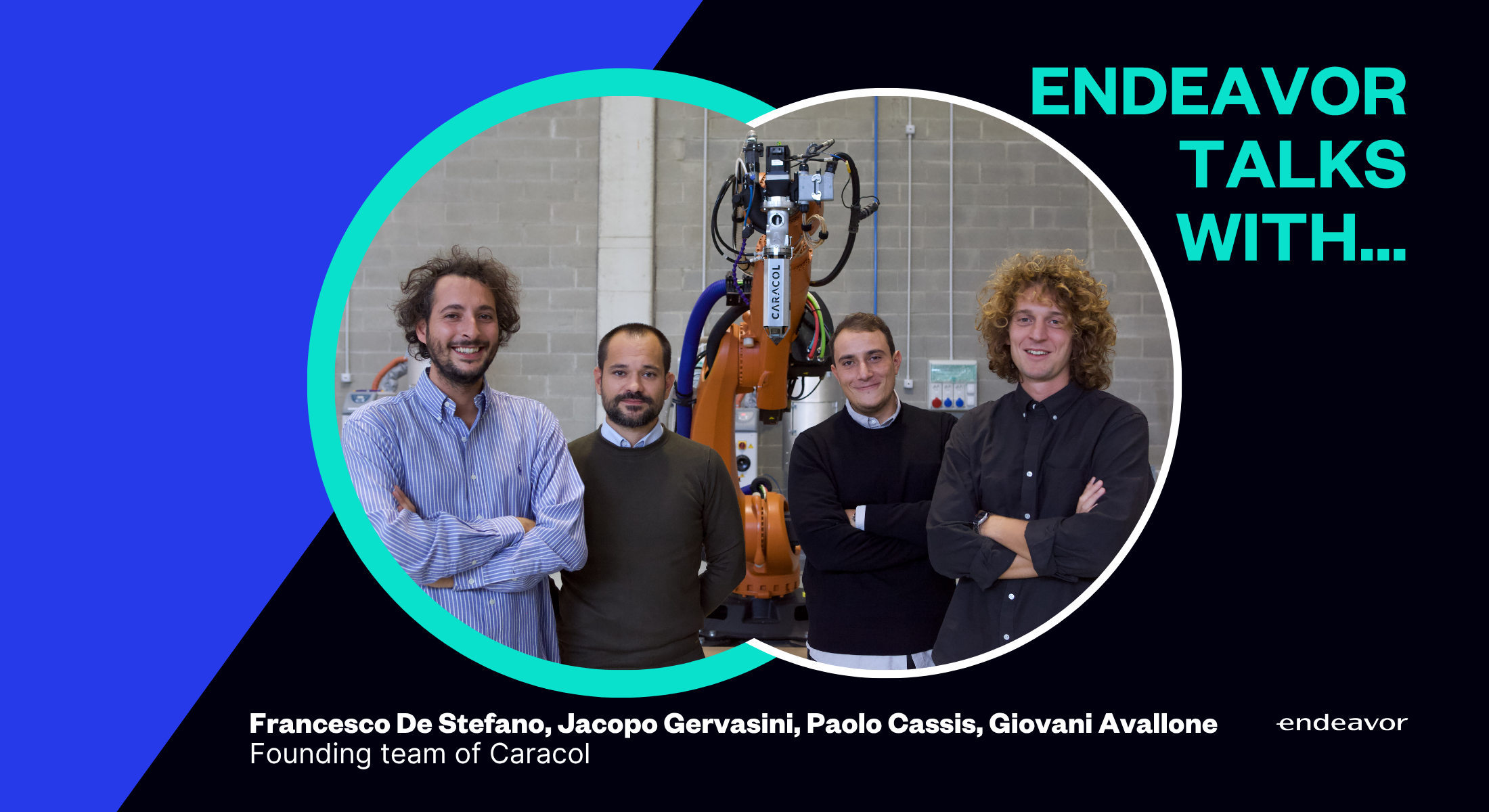
A chat with Francesco De Stefano, Jacopo Gervasini, Paolo Cassis and Giovanni Avallone, founding team of Caracol
Welcome back to Endeavor Talks With…!
This month we had a chat with Francesco De Stefano, Jacopo Gervasini, Paolo Cassis, Giovanni Avallone, the founding team of Caracol, a company born to overcome the limits of 3D printing and traditional manufacturing.
Happy reading!
1) You all have different backgrounds: how did you meet?
FRANCESCO: That’s true! Our team is quite diverse. We have two members with a technical background and two with a business background. I come from a management and consulting career, while Jacopo has a background in finance and administrative management. Giovanni and Paolo have a design engineering background from the Politecnico di Milano. What brought us together initially was our friendship, and then we discovered that all four of us were passionate about innovation applied to industry and manufacturing, albeit from different perspectives.
2) So, what happened next? What emerged after the team was formed?
JACOPO: The decision to embark on a research journey started with the advantages of 3D printing, but in a way, turned some of its limitations into an opportunity by combining it with robotics. This technology was then integrated into various industrial sectors, ranging from aerospace and automotive to marine industries.
3) how do you manage a Deep Tech company COMPOSED of 80% designers and engineers when your backgrounds are purely in business?
FRANCESCO: It’s clear that economics and finance come with strict operational guidelines that often clash with the freedom and creativity of the engineering and design world. However, we believe that our value relies on the balance we have struck between these two aspects. This momentary lack of balance raises an issue in the Italian deep tech sector, which is also present in the American sector, where there is a shortage of managerial profiles willing to launch ventures in industries with limited expertise or those that are considered “less sexy,” such as manufacturing.
4) Currently, Caracol is expanding in the US. What differences have you found between scaling a company in Europe and one in America?
JACOPO: Caracol originated in Milan and grew within the Italian industrial scene, which immediately gave the company an international outlook. Since 2019, we have begun to acquire clients from other countries, signaling that our business could go global. Before the COVID-19 pandemic, we were fortunate to go through an accelerator program in New York, which also prepared us for the American market. The uniqueness of the European market is the ease with which goods and people move between markets. Therefore, developing a solid European strategy while considering country-specific peculiarities isn’t too challenging. The difference with the United States lies in the key buying factors for clients, and there are also significant differences in terms of regulations. We immediately sought out local experts to support us during this transition, starting with our American customers, who had long trusted us right from the beginning.
5) Italy has many excellent technical universities where significant high-tech projects are created but often don’t make it to the market. Why is that?
GIOVANNI: The main issue here is undoubtedly the pace. The reaction times of traditional infrastructures are very slow, and there’s a risk of getting entangled in administrative and bureaucratic mechanisms. Being born as a spin-off of a university comes with advantages, but it also ties you to certain internal dynamics and rules, intellectual property issues, and limited autonomy. We still maintain a very fruitful relationship with universities, but it’s more of a partnership on equal terms, so to speak.
6) How could this be improved?
GIOVANNI: Perhaps, by granting more autonomy from the outset and being more flexible. There are outstanding business and management companies on a regional level in Italy, so a direct collaboration between these entities and universities unlocks significant growth and profit. Perhaps this is a provocative statement.
7) Until a few years ago, it was common to associate a company with one person, the founder. Today, however, a multi-founder model is emerging. Why has this happened?
FRANCESCO: It’s likely a product of the times we live in. We’re in an era of exponential acceleration on all fronts, where everything is constantly evolving, and the level of specialization required to seize all opportunities is quite high. Founders have ended up “multiplying” because the single leader of the past is no longer sufficient.
Leadership models have also evolved, and the idea of the monarchical CEO and pyramid-shaped governance models no longer fit with global patterns that can suddenly change and require constant, individual pivoting. In other words, the work has become too complex for a single person to handle.
8) How is it from a human perspective?
PAOLO: The four of us are quite different, and we quickly realized that this was our strength. Even investors have constantly highlighted the cohesion of the team as one of our strong points.
9) You went through the entire process within Endeavor, first the Elevator program and then the process that led you to become Endeavor entrepreneurs. Tell me more about that.
JACOPO: We were already familiar with Endeavor, and getting in was one of our goals. It’s truly an honor to have succeeded, especially because it wasn’t easy at all! Elevator gave us visibility in the Italian scene, and even just being able to tap into a small part of Endeavor’s network allowed us to create valuable connections with potential clients, mentors, and investors.