A chat with Alessandro Fracassi, CEO of Gruppo MutuiOnline S.p.A.
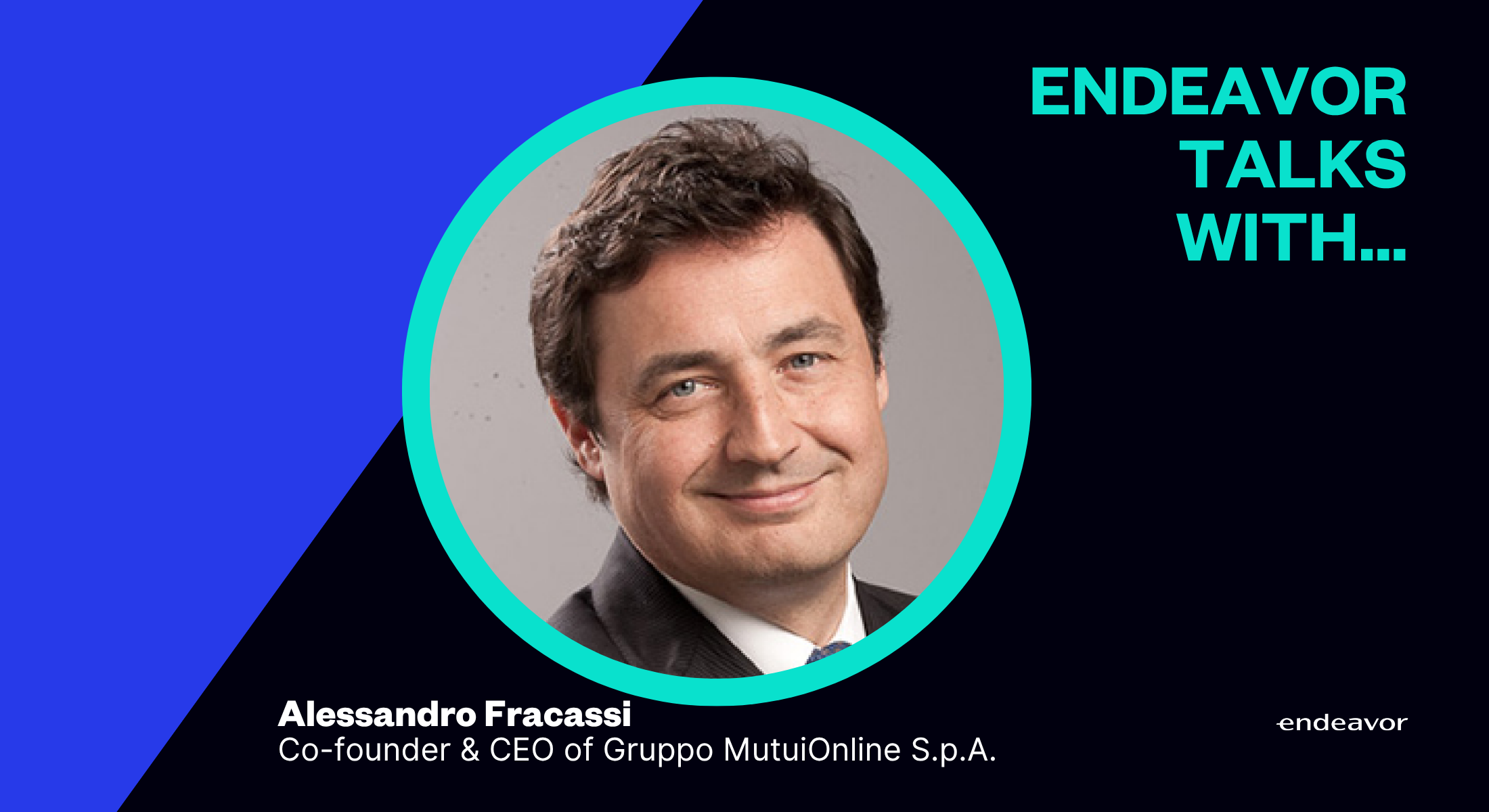
Welcome back to Endeavor Talks With…!
This time we sat down with Alessandro Fracassi, CEO of Gruppo MutuiOnline S.p.A., a leading retail credit and insurance broker in Italy, and Endeavor Italy Board Member.
Happy reading!
1) WHEN DID YOU FIRST HEAR ABOUT ENDEAVOR?
I first heard about it from Pietro Sella, who invited me to an event where a representative from Endeavor Global was also present. I remember him saying to me, “Look, this is great stuff I’ve been involved in. I find it a very interesting way to promote entrepreneurship, and I’d love for you to be a part of it.” I had been looking for opportunities to “give back” since 2008, that is, to help the Italian entrepreneurial ecosystem, because I became an entrepreneur by chance, not by aspiration: university and school had done nothing to teach me that this possibility existed. I wanted to contribute so that the new generations could look at entrepreneurship differently, as is done in other countries.
2) AND WHAT CONVINCED YOU IN THE END?
Absolutely the organization, and the fact that a major financial commitment was asked of the board members right away. All the other organizations I had come into contact with in previous years were based too much on volunteer logic, which only works when coupled with professional logic. You need people at the right level who are dedicated to just that, not people who do it in their spare time, otherwise the structure doesn’t stand up. And for that, of course, you need money. Endeavor’s approach to this convinced me that this could work. I was also convinced by the people. The company you do things with is one of the deciding factors, as in everything.
3) WHERE DO ENDEAVOR AND ‘YOUR WORLD’ MEET?
They intersect in so many places. Some of the businesses supported by Endeavor are adjacent to, complementary to, or even in competition with what I do. The second point where we meet is the issues that entrepreneurs bring to you: the Italian market, the end market, or the resource market. And then it’s a meeting in the broadest sense: you recognize yourself in the people in front of you, who may be a step behind you in their entrepreneurial history but face what you face as well, just from different perspectives.
4) WHAT DO YOU VALUE IN A COMPANY WHEN YOU FIRST MEET IT?
In a company that doesn’t have a long history, I evaluate the entrepreneur. The company is still in its potential, and the way to express this potential is through the intelligence, drive, and qualities of the people in front of you. The next aspects are the most obvious: growth of the target market, the company’s defensible competitive advantages over present or future competitors, and what differentiates it from others. These competitive advantages are articulated in different factors; for example, there are patents.
5) WHAT MAKES THE DIFFERENCE BETWEEN A SUCCESSFUL START-UP AND ONE THAT FAILS?
Here we have to give an answer that has been heard a thousand times before: the difference lies in the ability to execute. It is without a doubt the first point, and it should never be taken for granted.
Take two identical start-ups, the same idea, the same strategy, the same competitive advantages: what makes the difference is the ability to transform the project into reality, to make things happen, to choose the right people and motivate them in the right way.
Then there’s a second correlation: if you’re in a strategically unsustainable place or time, you may be a wizard, but it’s hard to pull it off. Only very skilled teams can survive in these circumstances, and they have to be willing to accept that their model isn’t working and reinvent themselves, even radically.
6) WHAT WOULD YOU SAY, CONCRETELY, IS THE ABILITY TO “EXECUTE”?
For me, it’s the fact that the entrepreneur or business owner gets in there, looks at all the details of what’s going on, and recognizes right away what’s not working so they can fix it quickly. You have to “foresee the bad,” as one of my co-workers says. You have to be a little paranoid and read the negative signs before they become obvious.
7) WHAT DO YOU CONSIDER YOUR GREATEST ACHIEVEMENT?
The MutuiOnline story is a success story, and also a good one from a strategic standpoint. From the very beginning we kept a very clean and precise strategic line, and we were very disciplined, which I think is important. The truth is that in this great success there have been countless mistakes and bumps in the road. One of the things I’m proud of is that for the past few years we’ve decided to become a “collector of entrepreneurial stories.” There are small excellences that need to be inside larger realities, and we have become their home: we are not financial investors, but we provide them with our resources to accompany them in their new growth.
8) AND YOUR BIGGEST MISTAKE?
When I say they are countless, I’m not kidding. I’ve made plenty of mistakes and continue to make them, but that’s normal. We are all human beings with limits, after all. Most mistakes are made in good faith, based on calculations and motivations that seem right at the time, and I must say those are the ones you regret the most. One mistake in particular: for years we told ourselves that we would never enter the insurance comparison market, because the earnings didn’t seem sufficient to keep the business going. We were confident of that because we had seen a start-up in that industry fail at the same time as ours. When we were already a listed company, British investors urged us to enter that market, because it worked well there. I explained that it would not be possible in Italy. Our refusal gave rise to our biggest and most formidable competitor.
9) WHAT HAS CHANGED FOR YOU AS YOUR COMPANY HAS GROWN?
It was a shock to realize that I could no longer do anything on my own, that I had become part of a structure and my presence didn’t have the same impact as before. There are areas where I still make a difference, such as important negotiations, resolving a crisis, or the strategic choice of an acquisition… but the truth is that in an industrial business, both mistakes and successes belong to the organization, not to you as a person. What remains only with the founder is the responsibility to set the motivation, incentives, and attitude that keep people aligned.
10) WHAT DID THE COVID-19 CRISIS TEACH YOU?
It taught me how powerful the informal leadership mechanisms provided by physical presence in an office were. It’s very true that working remotely doesn’t make performance worse; in some cases, it can even improve it. But work is also the environment in which you work, not just the content of the work itself. The place, the people next to you, what you do on your breaks… all of this is part of the motivation to get up in the morning. You don’t just think “I’m going to work,” but also “I’m going to meet the colleague I chat with over coffee” or “I’m going to see the colleague I have a crush on.” All of this has been swept away, and only the backbone of work remains, namely tasks.
11) AND HOW IS THIS NEGATIVE?
It’s negative because everything that used to motivate us on a daily basis, the human side, has disappeared.
Everything that used to motivate us on a daily basis, the human side, has disappeared.
We had the highest number of resignations this year from people with high company seniority, and I don’t think that’s a coincidence. Some informal processes have disappeared too. When I walk into the office, I go around and greet everyone. It doesn’t seem to be of any use, but it is useful for gauging morale and catching moments of dissatisfaction or problems. All of this has a concrete utility. We can’t pretend that its absence hasn’t had an impact.
12) IS DIGITAL AND TECHNOLOGICAL DEVELOPMENT AN ENEMY OR AN ALLY OF TRADITIONAL SMEs?
It depends a lot on the SMEs. When I think of Italian SMEs, I would say mostly an opportunity. Conversely, it’s a big threat to the professional world, which should be more concerned than it is. I think there will be some strong rearguard battles. Companies like mine, for example, have created tremendous economic damage to traditional insurance agents. But it was inevitable; it’s the technological process that changes how markets work. And this will happen in many other areas, even those considered “protected” today. This does not mean that professions will no longer exist, but it will be necessary to know how to use these technologies to one’s advantage.
13) IN WHICH AREAS DO YOU SEE THE MOST GROWTH AND THE MOST POTENTIAL IN THE NEAR FUTURE?
If you’re talking about the immediate, I think we’re going to see incredible growth in everything that COVID-19 has forced us not to do. After that, it’s clear that industry policies of investing in digital technologies, and environmental sustainability issues, will lead to secular trends, as analysts call them.
14) WHY DO YOU THINK A COMPANY LIKE ENDEAVOR IS IMPORTANT IN OUR COUNTRY?
I believe that never before have we realized that growth is not made by policies, but by the people who create companies and make them grow, who ask themselves every day how to take advantage of secular trends, how to correct the mistakes they’ve made, how to make the best use of technology… This is what makes countries, and consequently individuals, grow. I believe that Endeavor is one of the elements that favors this growth through stimulation, research, and comparison with global realities. It is not certain that Endeavor can bring the same value to every single company in the network, but
I am 100% sure that Endeavor brings awareness of the importance of seeking international growth paths and makes it possible.
Even just participating in the events, or even better, in the Endeavor selection process, even without being chosen, is a great opportunity. In fact, I would say that the value of Endeavor lies above all in the selection process, because it requires you to think and structure yourself in an effective way. Even going to the International Selection Panels is a wonderful experience: you meet people at the highest level in a way that is not only professional, but also informal, and you can say you’ve really met them. And then there is nothing more exciting than being immersed in the energy of those who come to tell you about the company they are building and their plans for the future. I always take home an incredible amount of energy.