Chiara Petrioli (Founder & CEO W-Sense)
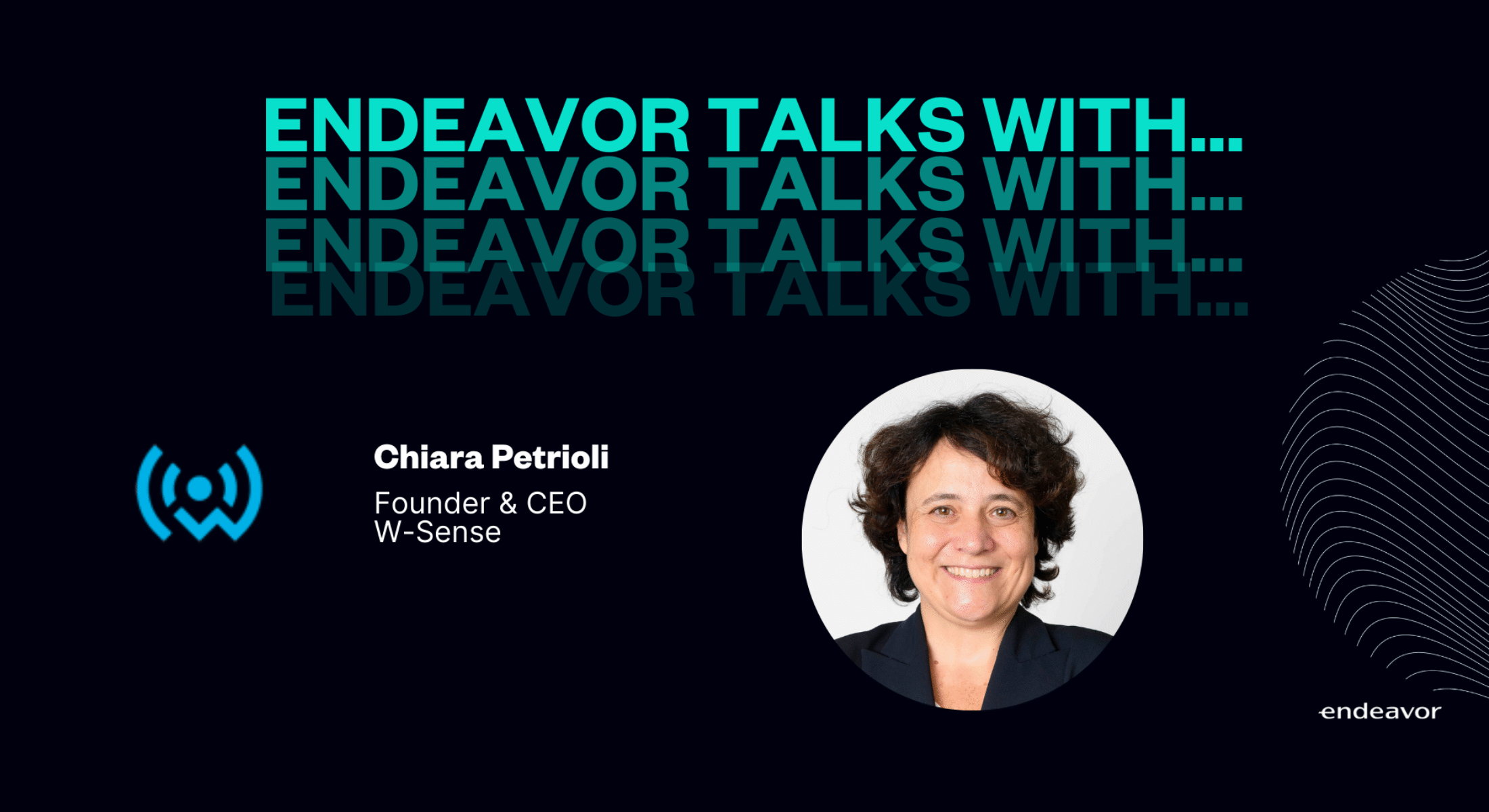
Welcome back to Endeavor Talks With…!
This time we sat down with Chiara Petrioli, Founder & CEO of WSense, a deep-tech company born as a spin-off of Sapienza University of Rome and a pioneer in the Internet of Underwater Things.
WSense develops advanced underwater wireless communication networks that connect subsea sensors, infrastructure, and autonomous vehicles, enabling real-time monitoring and data exchange.
Its technology supports applications across the Blue Economy — from energy and critical infrastructure to environmental monitoring and offshore operations — bringing reliable connectivity to one of the most challenging environments on the planet.
Happy reading!
1) tell us about yourself – who are you?
I’m Chiara Petrioli, a computer engineer, Full Professor at Sapienza University of Rome, and Founder & CEO of WSense – a deep-tech company that started as a university spin-off and now operates internationally in the Blue Economy.
My career began in academic research. For years I worked on wireless networks and embedded systems, then led cutting-edge European projects on the Internet of Underwater Things. At a certain point, I felt the drive to take those technologies beyond the lab and turn them into real-world solutions and that’s how my entrepreneurial journey started.
2) When did you realize research wasn’t enough anymore, and that it was time to build an entrepreneurial venture?
It happened when I realized the technologies we were developing could genuinely make a difference in the real world, but only if deployed at scale. Research helps identify problems and propose solutions, but to create real impact you need a bridge to industry. I felt the need to build that bridge: WSense was born to close the gap between science and the market, turning knowledge into products and innovation that can actually reach the real world.
3) What was the hardest step in turning a scientific project into a scalable company?
Without a doubt, the jump from prototype to a real industrial product. In a lab you can optimize everything in controlled conditions; in the real world you have to guarantee reliability, interoperability, cost sustainability, and operate in extreme environments.
At the same time, there’s also a cultural shift: moving from an academic mindset, where the goal is publishing, to an entrepreneurial one, focused on outcomes and scalability. You need new skills, a multidisciplinary team, and the ability to attract funding.
Seeing a technology come to life is something research alone can’t give you.
For me, entrepreneurship is a natural extension of the scientific path.
4) From the outside, the “Internet of Underwater Things” sounds almost like science fiction. What are the most immediate, concrete applications of what you do?
Our underwater wireless networks enable real-time monitoring of critical energy infrastructure — like pipelines, power cables, and offshore plants — and the collection of key environmental data (temperature, oxygen, CO₂, pH, salinity, acoustic noise) down to 3,000 meters. We also connect fleets of autonomous underwater and surface vehicles for maintenance and research missions.
These technologies are already being used across energy, defense, telecom, and environmental protection, and they’re the first steps toward a new connectivity paradigm for the marine domain.
5) How do you bring technology and environmental impact together? Can innovation really help protect the planet?
Absolutely, if it’s designed for that. At WSense, sustainability is central: our solutions reduce the need for large vessels and invasive operations, cutting emissions by up to 90% versus traditional systems and lowering operating costs by around 20–30%.
Most importantly, by providing real-time data on marine ecosystems, we help prevent damage and manage resources more consciously. Knowledge is the first step to protection. That’s what it means – as we say – to “give voice to the oceans.
6) What qualities and skills do you need today to lead a deep-tech startup that wants to grow globally?
You need a rare mix of deep scientific expertise, strategic vision, market understanding, and leadership. You have to read complex contexts — technology, economics, regulation — and build teams that bring together innovation, business, and communication.
And then there’s resilience: in deep-tech, timelines are longer, validation cycles are slower, and investments are more demanding. It takes conviction, patience, the ability to question yourself, and a strong appetite for calculated risk.
7) What’s your relationship with mistakes, and is there one you made that taught you something?
I see mistakes as a key part of personal and company growth — especially in a deep-tech startup like WSense, which started in a garage and is helping build a completely new market. In an emerging space like the underwater domain, there’s no roadmap: you have to recognize mistakes and learn fast.
We faced challenges early on — including losing key people — but we turned them into opportunities to improve products, solutions, and processes. It took resilience and humility, and a “Socratic” mindset: learning from what didn’t work and getting stronger.
It also means acknowledging your limits: knowing where skills are missing, bringing in the right talent, and learning from others to keep growing internationally.
8) Is there anything you miss about being a “pure” researcher? Would you ever go back?
Seeing a technology come to life is something research alone can’t give you. For me, entrepreneurship is a natural extension of the scientific path.
9) You took part in the 2025 edition of our Elevator program and, in the same year, you became an Endeavor Entrepreneur – the full journey! What was it like, and how did it help you?
When I joined Elevator, WSense was entering a phase of very rapid growth: we were scaling our technology and navigating a market that was still taking shape.
Elevator offered something unique: a true community of trust with founders who have built international success stories. Regular exchanges, mentoring, and very practical discussions on growth challenges helped me sharpen our decisions, accelerate execution, and approach internationalization with more confidence.
I also realized Endeavor is not only a network for talent and capital: it’s a platform to create synergies with international companies, explore new markets, and unlock new growth opportunities. I’m genuinely proud to be part of it.
Endeavor is not only a network for talent and capital: it’s a platform to create synergies with international companies, explore new markets, and unlock new growth opportunities.
I’m genuinely proud to be part of it.